
YSmarines provides high-quality roller fairleads with reliable prices and fast delivery.
ISO13776 Pedestal Roller Fairlead
The pedestal fairlead is manufactured in accordance with the ISO 13776 standard. The actual SWL of the fairlead on board shall be determined by considering the under deck reinforcement and shall not be over the SWL indicated in this International Standard. Depending on the rollers on the top, the fairleads shall be classified as two types including the cylindrical pedestal and conical pedestal. Besides those, other options such as square or customized pedestals according to the requirement of clients are available
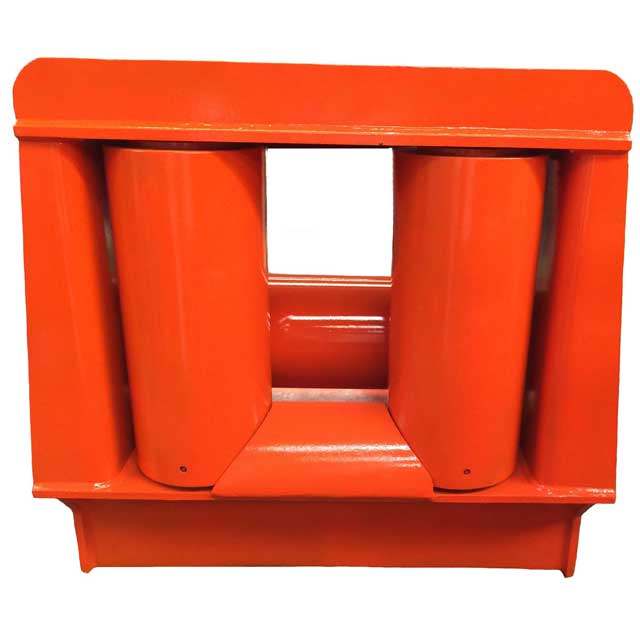
ISO13742 Roller Fairlead Without Upper Roller
The roller fairlead is made according to ISO 13742 standard without upper roller and it is a universal fairlead consists of horizontal and vertical universal rollers to increase stiffness and fairlead strength, guiding mooring ropes from all directions, greatly reduce the abrasion of mooring ropes. The fairlead compact structure and reasonable openings are not only for ordinary vessels towing or mooring but also for navigation in the canal waterway ship is towed or moored. The certificate of BV, ABS, LRS, DNV, RS, IRS, etc is available for ISO13742 fairlead
ISO13733 Roller Fairlead with Upper Roller
The roller fairlead is manufactured according to the ISO 13733 standard with an upper roller. It is a type of ship’s mooring fitting installed on board to lead the mooring rope from the ship’s inboard to outboard. The fairlead is also known as universal fairlead because it can lead the mooring ropes from different directions. All surfaces shall be free from any visible flaws or imperfections. It is coated externally with an anti-corrosion protective finish. The rotating parts are provided with greasing. Depending on the construction, the roller fairleads shall be classified as four types as below, which includes type 4R, type 5RL (with additional guide roller on the left side), type 5RR (with additional guide roller on the right side) and type 7R.

Horizontal Guide Deck Sheave
The horizontal sheave is a type of mooring fittings to guide the mooring rope horizontally on the deck. It is also named the horizontal deck sheave fairlead. It is built to withstand breaking strength of indicated rope at 90-degree sheave wrap on the sheave. The warping angle of the sheave can be 90-180 degrees. It is made from cast steel with hardened rope groove for longer life. It is on a weld down the mounting base with an epoxy primer coating.

DIN 81906 Warping Roller Fairlead
The warping roller is made according to the standard of DIN 81906-1999. It must be identified clearly and permanently with the nominal size and manufacture’s symbol. It is made from cast iron or cast steel material and the materials must conform to the DIN standard’s requirement, which increases the durability, good wear and corrosion resistance to ensure a long service time. Its maximum towing load is from 10KN to 320KN. It is used to guide rope or cable.
CB/T 3062 Roller Fairlead
The roller fairlead is made according to the standard CB/T3062-2011 and also is called the roller head fairlead or universal fairlead. It is designed for mounting free on deck, and welding into the bulwark with a rope turn of 90°. The rollers and axles are interchangeable. The surface of the rollers do not have any defects which affect its performance and intensity such as cracks, blisters. The fairleads are designed with 3 rollers, 4 rollers and 5 rollers easily adapted to meet clients’ requirements, which are A-type (3 rollers), B type (4 rollers) and C type (5 rollers).

A40 Swivel Head Anchor Fairlead
The A40 swivel head anchor fairlead is the heavy-duty single sheave fairlead. It is made of high-quality steel. It is fitted with a removable guide roller and hardened rope groove to ensure long-time use. It is suitable for use in most deck-mounted or flange-mounted marine-duty applications, which can be manufactured with welded foundation or bolted foundation. It can be used for guiding ropes in ship mooring and will not break down. The fairlead is designed for breaking strength of wire with 90° wrap on sheave and +/- 90° rotation of swivel head.

A38 Swivel Head Anchor Fairlead
A38 swivel fairlead is one kind of the heavy-duty double sheaves fairlead. And the anchor fairlead can be supplied with a welded and bolted foundation for the installation on the deck of vessels or on the dock. It is one kind of roller fairleads with high breaking strength to suit wire rope for ship mooring. It is designed with 90° wrap on sheave and +/- 90° rotation of swivel head. The shape of the opening is approximately elliptical.
A39 Swivel Head Anchor Fairlead
The swivel head fairlead is the heavy-duty balanced anchor fairlead and is installed on the deck of ships. It is suitable for use in most deck-mounted or flange-mounted marine-duty applications, which can be manufactured with welded foundation or bolted foundation. At the beginning and end of the fairlead, there are the same size front panel and back panel. The surface of the opening is smooth to avoid the abrasion of anchor chains. With the compact structure and reasonable opening, the swivel fairlead is applicable to not only ordinary ship towing or mooring but also to ships sailing in the canal waterway.
For more detailed information, click the Contact YSmarines page.
Auxiliary equipment has high working efficiency and guarantees that the rolling mill saves rolling time with high output. The structure of the equipment should be advanced and reasonable with flexibility in movement, easy to operate and maintain. The standardization of spare parts is necessary with easy manufacturing. The production capacity of the auxiliary equipment is generally greater than the rolling mill to ensure production capacity of the rolling mill. The equipment design is economical and reasonable with small in size and light in weight.

Rebar Bar Packing Machine
The advantages of rebar bar packing machine includes fast and efficient, automatic, uniform operation and high safety. With the machine, the packed products include 6.5,8,10,12mm wire, steel bar/pipe/tube, stainless steel tube, aluminum tube,rubber tube, shapes, etc. Double-ring & double-rub wheel devices make working safer stable & energetic. Special conveying device is easy for loading & conveying the package strengthens the transfer capacity. Wide packing belt can be used for cutting the packing cost & making the work more efficiency. Separate control panel makes operation & maintenance become easy. Material tension could be adjusted automatically.

Wire Take-up Machine
Wire take up machine is used to the winding of copper wire, aluminum wire and steel wire rod. The machine is equipped with a torque motor and its speed is adjustable. It can be used with wire drawing machines, rolling mills and other equipment. Spool take-up machine can make the process coherent. It is easy to operate. According to the closing weight, the rebar take up machine can be divided into 0.5 ton class, one ton class and two ton class.
The vertical steel wire winding machine automatically places the wire on the rotating wire rack. The machine can automatically place the wire and deposit much wire. The amount of the deposited wire is determined according to the height of the wire rack, generally, it is between 500 and 3000 kgs. After the rack is full, the wire is pulled out and removed, then change to an empty rack. This machine can work continuously. The vertical steel wire winding machine has the advantages of high-temperature resistance, high speed, and the same level of the three-level disk screw in large steel plants. It has a neat appearance and is easy to transport. It is the ideal equipment for medium and small wire drawing plants.

Pinch Roller Machine
The pinch roller machine is used to hold the rolled parts and feed them into the laying head. The pinch speed is 0-30m / sec and the products are pinched are Φ5mm--Φ25mm round steel and wire. The machine consists of the operation part and the transmission part which are welded at the whole bottom pallet. The elevation movement of the upper roller is realized by the auxiliary motor through the auxiliary reducer, which drives worm and worm wheel under the left and right roller bearing to move automatically. The machine has full PLC programming control, stable and reliable system, digital panel for easy operation and It can achieve 100% synchronization for up and down roller with large feeding force, fully automatic control.
For more detailed knowledge, please click on the page of TINVO rolling mill articles

Mechanical spring starter can start diesel engines in any special environment releasing the spring’s potential energy. The spring starter requires no battery or any other external system, only by hand. It is the ideal backup starter, especially suitable for firefighting, emergency rescue, military, marine and other environments that require high starting reliability. It is also the best starting solution of “black start” or “dead-ship start”.
I guess everyone will work with an engine in daily life, and the most common engines are car engines and motorcycle engines. As we all know, the engine is the source of power that can bring power to modern society.
While every engine must be started by the starter, the common starter is an electric starter that needs a battery to provide energy. Other starting methods like air starter, require an external system to provide energy. All of them rely on external power; once they lack external power, the engine is “dead”.
Although the electric motor is convenient and even automatic, it still needs maintenance. If the starter is out of maintaining or out of electricity, the engine won't start. It is fine for common situations, but it will cause bad results if it is an emergency.
But how can we avoid this? It is easy to understand the principle and solve the problem. Let’s focus on the engine of a motorcycle, every motorcycle will be equipped with a kicking starter for start engine. It is an easy and simple way to start an engine if the electronic starter doesn’t work.
We can also provide an alternate startup option for other engines, mechanical spring starter. It is based on different principles comparing with the kicking starter of a motorcycle. It can start a diesel engine in any special environment by releasing the spring’s potential energy. Cqstart spring starter, using a simple mechanical mechanism, stores the energy by compressing the springs and releases the spring’s potential energy by pulling the trip lever to turn the engine’s flywheel. The mechanical spring starter can apply to emergency generator sets, lifeboats, firefighting sets, emergency pump sets, construction machines, power plants, irrigation and drainage device, etc.
If you want to get more info about that, just click here: Chongqing Starting Power Unit Co., Ltd
The type of anchor you use can vary a lot, depending on the size and type of boat, the location of the boat, and the type of bottom material you’ll be anchoring into. Generally, it’s best to have a boat anchor on hand that will be effective in the widest variety of environments you’re likely to be encountering. But it some cases, you may want to have multiple anchors on board that can be used in different circumstances.
In this article, we’ll look at the various types of anchors, and zoom in on which ones are most effective in which environments and use cases.
What is an Anchor?
An anchor is a device attached to boats with a chain or rope to help the vessel stay in place. Almost universally made of metal, anchors vary in their design depending on the type of boat you have and the area you plan to use it in.
Types of Surfaces an Anchor Works With
When selecting an anchor to use, it’s important to consider the surface you plan to secure it in.Mud
Mud tends to be very thin which can pose a problem if you don’t use the right anchor. A mud anchor usually needs to be tilted to a 32-degree angle in order to fully secure itself to the ground.
Sand
Sand is one of the most common surfaces an anchor needs to work with. Because it’s so soft, it’s easy for anchors to secure themselves into it.
Rocks
Rocks can hold an anchor well, but it’s important to have a sharp anchor that can dig in between them. A plow-shape anchor is best for a rocky surface as it quickly pokes into the rocks.
Grass
Grass is a challenging surface to use an anchor in. This is because the anchor might twist itself into roots rather than into the ground. Because of this, it is important to use an anchor that can cut through roots and grass.
Clay
Some surfaces might be made of clay. Clay is very difficult for some anchors to attach to because it’s so compact. Due to this, there are special anchors designed specifically to be used in clay and feature extremely sharp tines that pierce through the ground.
Coral
Coral is a pretty similar material to anchor into as rock. For the most part, anchors that work well in rock will work well in coral.
Types of Anchors

Danforth Anchor
Also known as a fluke anchor, the Danforth anchor features two flat triangular grooves on the edge of it. This anchor is very lightweight and works well in mud and sand. The two fluke prongs attach quite well in muddy and sandy bottoms — which are by far the most commonly encountered types of ground. The Danforth is easy to work with, and easy to stow, making it a great general purpose anchor.
However, it functions poorly in rocky, grassy, or coral conditions
If you only want to have a single anchor on your boat that will work in a wide variety of circumstances, the Danforth fluke anchor is probably the one you’re looking for.

Stockless Anchor
The stockless anchor was one of the first anchor designs in the world. It’s known for its strong grip and doesn’t tend to be as heavy as other models. A stockless anchor features two flukes curving off its sides and a socket in the middle which helps it to sink. On the bottom of this socket are small palms which help the anchor to secure itself to the ground.

Mushroom Anchor
This type of anchor is designed to be used in sand or very fine surfaces. A mushroom anchor looks like a mushroom as it has a long rod connected to a circular bottom. This circular bottom works as a suction cup which helps the anchor to stay secure wherever it is placed. Eventually, sand can cover the top of the mushroom mooring anchor helping to keep it fastened to the ground even more.
These work great for small boats as a “lunch anchor”. They’re not designed for strong holding but will keep a small craft in place for a time in calm winds. They’re super convenient, compact, and easy to work with. They’re commonly sold with a vinyl coating.
When you’re not at the dock, you’ll need an anchor to secure your craft. These devices are crucial to have on hand for any boat. They help to keep the vessel secure and prevent it from floating away, and are especially important in hazardous conditions.
Auxiliary equipment to various machinery and equipment other than rolling mill. It consists of mechanical equipment used to complete a series of auxiliary processing procedures. According to the difference usages, auxiliary equipment can be classified into the flying shear machine, drawing machine, straightening machine, cooling equipment, lifting and transporting equipment, etc. The selection of auxiliary equipment is very important for rolling mill. The equipment should meet the requirements for product production.

Hot Rolling Mill Cooling Bed
The cooling bed is used for the rebar hot rolling mill production line and consists of a mechanical transmission system, a water cooling system, a cold bed work surface, and a fixed bracket. The cooling bed has the advantage of significantly reduce energy consumption and cost and improve the processing performance of metals and alloys. Hot rolling usually uses large ingots, which not only improves the production efficiency but also improves the rolling speed. The output of the cooling bed is 25ton/hour and the final dimension is Φ8-32 deformed steel bars. The Maximum bed load is 40 tons.
Rolling Line Water Cooling System For Steel Bar Production
The water cooling system in steel plants mostly is used in the rolling mill line for steel bar production. Operators can control flow and system cooling by pulsing each spray up to five times per second. Pulsing capability enables operation at lower flow rates without compromising impact, spray angle or drops size. The system will automatically adjust the cooling profiles based on the inputs from the shapemeter. The water cooling system for the rolling mill has modular design that allows for simple maintenance when needed. Typically, these self-cleaning valves require no maintenance for at least five years and are constructed of high quality, stainless steel internal components to ensure accurate, long-lasting performance.

Pickling-Free Rust Remover Machine
The pickling-free rust remover machine mainly is used for rust, polishing, lubrication, etc. The acid-free machine simplifies rust cleaning procedure. It can complete the shelling, rust removal, polishing, lubrication and other tools at a time. The newly wire treated has a longer rust resistance and can be used indoors for more than 6 months. There are various types of pickling and descaling machines, which can handle wires of different diameters: φ2.5mm-4.0mm, Φ5.5mm-8mm, Φ12mm-16mm, Φ16mm-24mm.
For more professional knowledge, please visit on the page of TINVO rolling mill articles