
Compression springs, extension springs, torsion springs, volute springs, circlips, and other spring types are among the most prevalent. So, do you understand what the most common spring materials are and what are spring production process?
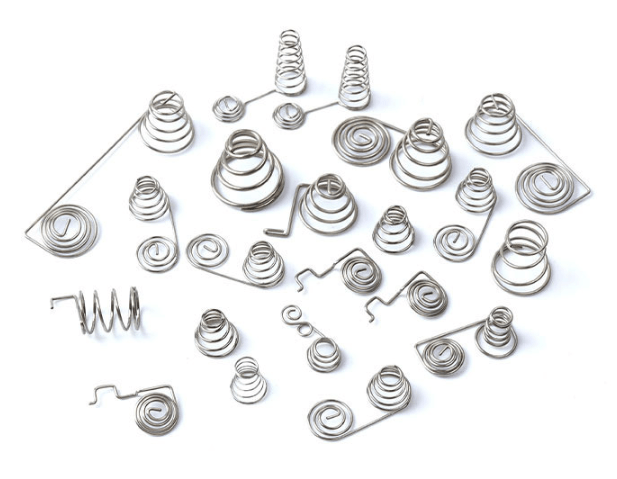
Metal spring materials that are commonly utilized
1. Spring steel, carbon spring steel: common grades include 70, 65Mn, T8, T9, and so on.
2. Alloy spring steel in grades such as 50CrV, 55CrSi, 60Si2Mn, and so on.
3. Stainless steel for springs, often used grades include 304, 316, 301, 201, 17-7PH, 12Cr18Ni9, 06Cr19Ni9, 07Cr17Ni7Al, and so on.
4. Copper alloys: Tin bronze, Silicon bronze, Beryllium-bronze, Brass/copper.
5. Nickel alloys: pure nickel, nickel-copper alloy, nickel-cobalt alloy, nickel-chromium alloy.
Non-metallic spring materials that are commonly utilized
1. Fluid material: gas (for example, a gas spring or a nitrogen spring), liquid (oil), or a gas-liquid mixture.
2. Ceramic materials are examples of inorganic materials. Rubber (rubber springs) and plastic fiber reinforced materials are examples of polymer materials.
Other special alloys include high-temperature alloy steel, Inconel, Hastelloy, high-speed tool steel, elastic element alloys, memory alloys, and so on.
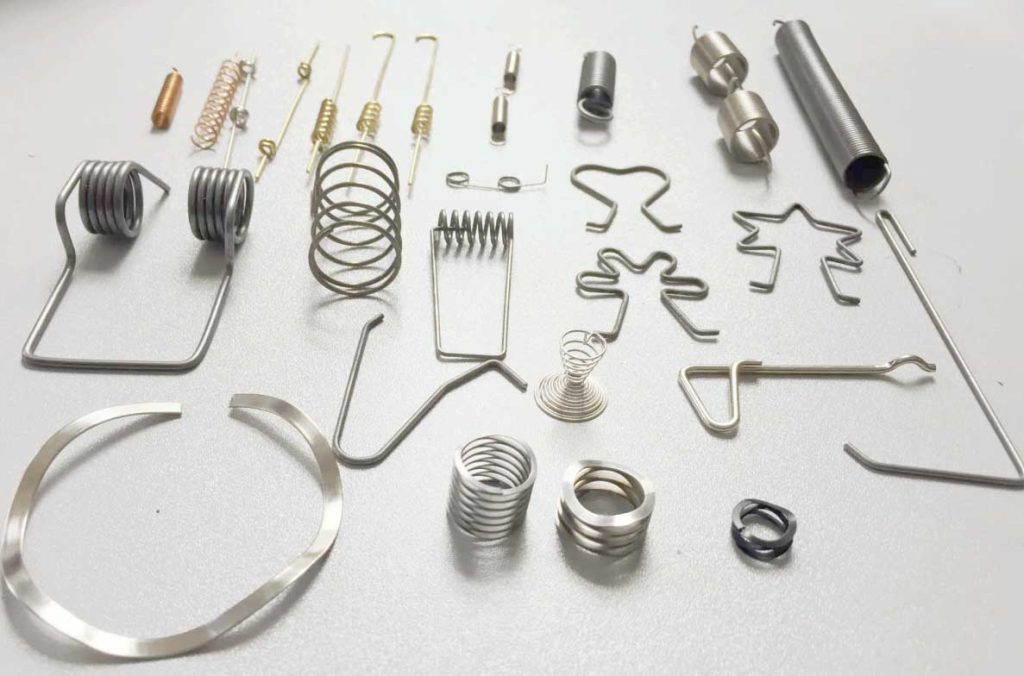
What Kinds of Spring Coating Elements Exist?
Galvanized
Zinc is relatively stable in dry air, changes little, and is difficult to change color. In humid air, a white layer of zinc oxide or zinc carbonate forms. This dense film protects against additional rusting. Blue and white zinc, yellow zinc, colored zinc, and black zinc are common platings.
Plating with cadmium
Cadmium plating is commonly used to protect springs against corrosion, whereas cadmium plating is utilized to protect the inner metal. Because cadmium is an anode in comparison to iron, when it is pulled or cracked, the exposed iron metal beneath it can be protected by the cadmium plate's consumption. Cadmium is commonly found in atmospheric corrosion.
Copper plating
It is used in casting, nickel plating, chrome plating, silver plating, and gold plating.
Chrome plating
It is a silver-white metal with a microstrip blue finish. The chromium plating layer is extremely hard, with a hardness range of 400-1200HV depending on the plating solution composition and process parameters. The thermal characteristics of the chrome plating layer are excellent. Its gloss and hardness do not alter when heated below 500 °C. When the temperature exceeds 500 °C, it begins to oxidize and discolor. The hardness begins to decline at 700°C. The chromium plating layer has a low friction coefficient, particularly the dry friction coefficient, which is among the lowest of any metals. As a result, the chromium layer is abrasive.
Nickel plating
Nickel plating has a silvery white and yellowish look. Nickel plating is the electrolytic or chemical method of plating nickel on metals or nonmetals. Nickel plating is attractive and can be used to decorate. The cost is significant, and the procedure is quite difficult.
Tin plating
Tin plating has a silvery white look. It is a surface treatment process that uses tin plating on the surface of a metal, alloy, or other substance to add beauty and prevent rust.
Silver plating
The primary function of silver plating is to prevent corrosion while also increasing conductivity, reflectiveness, and attractiveness.
Galvanized titanium alloy
Galvanized titanium alloy is less expensive. It is corrosion resistant and stable, not easily rusted, and has a reasonably high hardness. It will be stronger than regular titanium alloys.
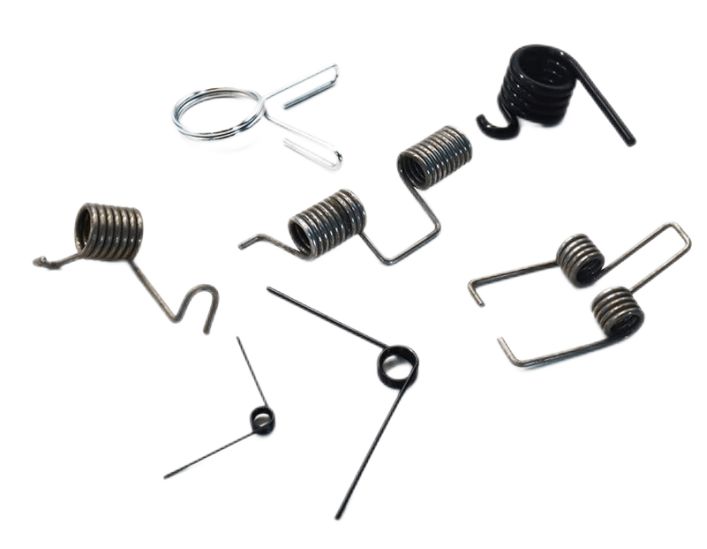
Spring zinc plating and cadmium plating play important roles
1. In humid air, a white layer of zinc oxide or zinc carbonate will form. This dense film protects against additional rusting. As a result, under typical atmospheric circumstances, the galvanized layer is used as a corrosion protection layer for springs. Springs in contact with solutions such as sulfuric acid, hydrochloric acid, and caustic soda, as well as springs working in humid air in an environment such as sulfur trioxide, should not be zinc-coated.
2. After plating, the galvanized layer is usually passivated. Passivation can improve the coating's protective function while also improving the surface's look.
3.The amount of protection is determined by the thickness of the zinc and cadmium coating. The thickness should normally be chosen based on the working environment during usage, and the thickness of the galvanized layer should be chosen between 6 and 24/m. The thickness of the cadmium plating layer should be chosen between 6 and 12/m.
KENENG has a big supply of different types of springs, such as compression springs, extension springs, torsion springs, die springs, battery springs, volute springs, disc springs, wire springs, flat spiral springs, etc, as well as bespoke springs, which can be designed and manufactured by our skilled spring design engineers based on your specific requirements or drawings.
Spring can be found in a variety of machinery. From consumer goods to large industrial equipment, removing anything requiring mechanical components may reveal a spring, which is a mechanical storage device. Types, properties, and applications of spring are discussed in this article.
Cylindrical Helical Spring
Circular cross-section type
It's a circular-section compression spring.
The characteristic line is linear, stiff, has a simple structure, is easy to manufacture, and has a wide range of applications. It is mostly employed in mechanical equipment as a buffer, vibration reduction, energy storage, and control movement.
Rectangular cross-section type
The cylindrical spiral compression spring with a rectangular cross-section offers more stiffness and absorption energy than the circular section type under the same space conditions. The characteristic line approaches the straight line, and the stiffness approaches the constant.
Flat-shaped section type
The cylindrical helical spring with a flat-shaped section has more storage energy and compression than the circular cross-section kind. As a result, it is frequently employed in applications such as engine valve mechanisms, clutches, and automatic transmissions.
Variable pitch type
When the load is increased to a particular degree, the spring gradually tightens the spacing from the section, causing the stiffness to increase. As a result, its autobiography frequency becomes variable, which has a positive effect on removing or reducing resonance and is extensively utilised in high-speed load-changing mechanisms.
Multi-wire type
Steel wire rope is the material. The contact between the steel wires is somewhat slack when not loaded. When the external load hits a particular threshold, the contact becomes tight and the spring rigidity increases. It is commonly utilised in weaponry and aircraft engines.
Extension Spring
The performance and properties of the cylindrical helical spring with a circular cross-section are the same. It is mostly employed in tensile load settings.
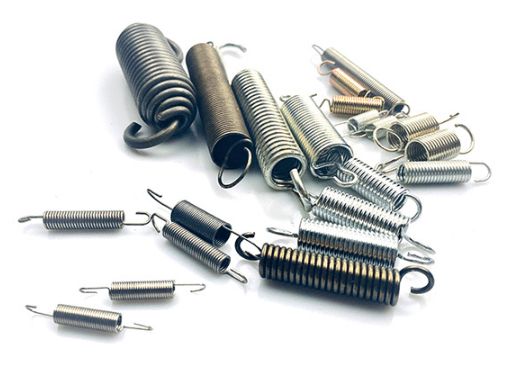
Torsion Spring
The torsion spring is under torsion load and is mostly utilised for compression, energy storage, and transmission system elasticity. It has a linear characteristic line and a wide range of applications, including measuring and metering as well as the compulsory air valve closure mechanism.
Spiral Spring
The spiral spring can absorb more energy in the same space than other springs, and the friction between the plates can be employed to dampen vibration. It is frequently employed to absorb thermal expansion deformation. The downside is that the distance between the boards is narrow and difficult to quench, making spray treatment impossible. Furthermore, the manufacturing accuracy is insufficient. It can be used as both a measuring and pressing element.
Torsion Bar Spring
The torsion bar spring has a simple structure, but the criteria for material quality and production precision are high. It is mostly utilised as a suspension spring in automobiles and compact vehicles.
Ring-shaped Spring
The ring spring is widely used in occasions that need to absorb large energy but is limited by space, such as springs for locomotive traction devices, and buffer springs for cranes and cannons.
Leaf Spring
A leaf spring is a metal piece that has a rectangular cross-section, which is mainly used for situations when the loading and deformation are not large. It can be used as a sensitive element in the detection instrument or automatic device.
Plate Spring
The plate spring is made of numerous spring steel plates bonded together. It is commonly employed as a suspension device in automobiles, tractors, and trains as a buffer and vibration reducer.
Rubber Spring
The distinguishing line progressively increases in length. This rubber-metal helical spring has greater stiffness than a rubber spring and greater damping than metal springs. As a result, it has great loading capacity, strong vibration reduction, and wear resistance, making it excellent for suspension structures for mining machinery and heavy vehicles.
Rubber-metal Spring
The distinguishing line progressively increases in length. This rubber-metal helical spring has greater stiffness than a rubber spring and greater damping than metal springs. As a result, it has great loading capacity, strong vibration reduction, and wear resistance, making it excellent for suspension structures for mining machinery and heavy vehicles.
Air Spring
An air spring is a non-metallic spring that achieves elastic properties by compressing air. It is commonly employed in vehicle suspension devices, which can significantly improve automotive power performance, therefore air springs are frequently utilised on vehicles and trains.
Although the spring is a minor component of the manufacturing business, it serves a significant role. Various types of springs include extension springs used in fitness equipment, battery springs in remote controls, and compression springs used in ballpoint pens and bicycles. But how much do you know about these springs, such as their properties, applications, categories, and customisation, and so on? This post will provide you a general overview of the spring.
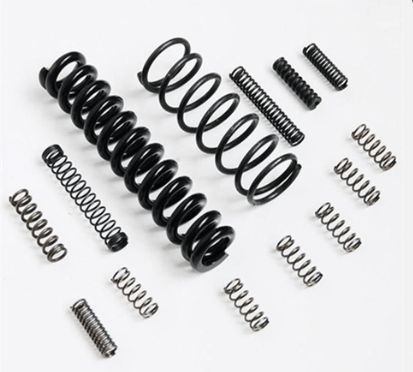
What exactly is Spring?
Definition
A spring is a mechanical component that works by utilising elasticity. Elastic materials deform when subjected to external force, and the original state is restored after the external force is removed.
Characteristics
Elongation and compression are features of springs. The spring's stiffness can be determined based on the application. The stiffness of a steel wire is determined by its diameter, the elastic modulus of the material, and its length in relation to tension and expansion.
Materials for manufacturing
Spring production materials should have high elasticity, impact toughness, and thermal treatment performance in general. Carbon spring steel, alloy spring steel, stainless spring steel, copper alloy, nickel alloys, and rubber materials are the most common materials used to make springs.
Wide Applications Of The Spring
Spring products play a significant part in the growth of the national sector. The expansion and improvement of the spring quality are required for mechanical equipment upgrading and enhanced host machine support performance. Toys, locks, staplers, ballpoint pens, fitness equipment, mattress, sofa, suspension springs for passenger cars and small vehicles, detecting instruments, automatic devices, pressure meters, and so on are all examples of where springs are employed.
The Main Categories of The Spring
The spring is classified as tension springs, compression springs, torsion springs, and bending springs based on its mechanical qualities.
It is classified as disc springs, ring springs, leaf springs, coil springs, truncated cone scroll springs, torsion bar springs, and so on based on its shape.
The most commonly used springs are compressed springs and tension springs, the majority of which may be customised by expert spring manufacturers who use CNC computer control or mechanical spring machinery for the manufacturing process, ensuring automatic and labour-saving production.
1. Torsion Spring
Torsion deformation is represented by a spring. The spring's terminal structure is a torsion arm that can be formed into a variety of shapes. Torsion springs employ the idea of leverage by twisting or rotating elastic material that is soft and stiff, resulting in a high mechanical energy.
2. Extension Spring
It is an axially tensioned coil spring. When there is no strain on the extension spring, the coils are normally tight with no gaps.3. Compression Spring
It is a coil spring, and the material utilised frequently has a circular cross-section. It is constructed from rectangular and multi-steel rollers. Their forms are often cylindrical, conical, medium convex, and medium concave. It has a steady stiffness, a simple construction, a simple production process, a wide application, and is mostly employed in mechanical equipment with buffer, vibration dampening, energy storage, and control activity features.4. Disc Spring
Disc springs are excellent for bearing buffering and damping. diverse combinations can produce diverse properties, which are commonly employed in pressure safety valves, automated transfer devices, reset devices, and clutches.5. Wire Spring
The elasticity coefficient of the wire spring's thickness and density from top to bottom is fixed. This spring's design can provide the vehicle with a more stable and linear dynamic response, which is beneficial to the driver and allows for greater control of the vehicle. It is primarily utilised for high-performance modified automobiles and competition vehicles.6. Lowering Spring
Lowering springs are shorter and thicker than original springs. Installing the spring significantly reduces the gravity of the car body and the inclination when turning, making the turning more stable and smooth, and increasing vehicle handling in bends.Spring Customization
Customized spring and inventory spring, which is better?
A bespoke spring is preferable when a precise spring size is required. If you need the spring right away, the inventory spring may be the best option. If you don't need to customise it, using the original spring can save you money.
These two types of springs, on the other hand, are cost-effective. In some circumstances, a customised spring is a more cost-effective option because you can acquire a correct size for the first time.
Professional custom spring supplier – KENENG
With 20 years of designing, researching, and developing, manufacturing experience, and a variety of standard and customised sizes available, KENENG is one of China's leading spring suppliers, offering both regular stock goods and customised service. KENENG, as a competent bespoke spring maker, can suit a wide range of industrial requirements, with diameters ranging from 0.1 to 80mm. KENENG can supply spring customization in the form of drawings, turning direction (left and right hand), material, finishing, wire diameter, spring force, end type (closed, grounded, close and grounded, open), and unique processing technology for the spring.
Spring is everywhere in various machines. From consumer goods to heavy industrial equipment, as long as you remove anything involving mechanical devices, you may find the spring inside, which is a mechanical storage device.

Cylindrical Helical Spring
Circular cross-section type
It is a compression spring with a circular section.
The characteristic line is linear, stable in stiffness, with a simple structure, convenient manufacturing, and wide application. It is mostly used as a buffer, vibration reduction, energy storage, and control movement in mechanical equipment.
Rectangular cross-section type
Under the same space conditions, the cylindrical spiral compression spring with a rectangular cross-section has greater rigidity and more absorption energy than the circular section type. The characteristic line is closer to the straight line and the stiffness is closer to the constant.
Flat-shaped section type
Compared with the circular cross-section type, the cylindrical helical spring with a flat-shaped section has large storage energy and large compression. Therefore, it is widely used in the installation space such as engine valve mechanisms, clutch, and automatic transmission.
Variable pitch type
When the load is increased to a certain degree, as the load increases, the spring gradually tightens the spacing from the section, and the stiffness gradually increases. Therefore, its autobiography frequency becomes a variable value, which has a good effect on eliminating or easing resonance and is widely used for high-speed load-changing mechanisms.
Multi-wire type
The material is steel wire rope. When it is not loaded, the contact between the steel wires is relatively loose. When the external load reaches a certain degree, the contact is tight and the spring rigidity has been increased. It is widely used in weapons and aero motors.
Extension Spring
The performance and characteristics of extension springs, are the same as the cylindrical helical spring with a circular cross-section. It is mainly used in situations under tensile load.
Torsion Spring
The torsion spring is under the torsion load, mainly used for compression, energy storage, and the elasticity of the transmission system. It has a linear characteristic line and wide applications, such as measuring metering and the compulsory air valve closure mechanism.
Conical Coil Spring
The role is similar to the variable pitch cylindrical helical spring. After the loading reaches a certain degree, the spring is gradually tightened from the large coil to the small coil. The stiffness increases gradually and the natural frequency is variable. It is conducive to eliminating or easing resonance and the anti-resonance capacity is strong. This spring structure is compact and stable. It is mostly used to withstand large loads and vibration reduction. For example, suspension springs are applied in heavy vibrating screens and automobile transmissions.
Spiral Spring
Compared with other springs, the spiral spring can absorb larger energy in the same space, and the friction between the plates can be used to attenuate vibration. It is often used to absorb thermal expansion deformation. The disadvantage is that the gap between the board is small and difficult to quench and the spray treatment cannot be performed. In addition, the manufacturing accuracy is not high enough. It can be used as a measuring element and pressing element.
Torsion Bar Spring
The torsion bar spring has a simple structure, but the requirements for the quality of materials and manufacturing accuracy are high. It is mainly used as a suspension spring for cars and small vehicles.
Ring-shaped Spring
The ring spring is widely used in occasions that need to absorb large energy but is limited by space, such as springs for locomotive traction devices, and buffer springs for cranes and cannons.
Leaf Spring
A leaf spring is a metal piece that has a rectangular cross-section, which is mainly used for situations when the loading and deformation are not large. It can be used as a sensitive element in the detection instrument or automatic device.
Plate Spring
The plate spring is laminated of multiple spring steel plates. It is widely used as a suspension device in cars, tractors, and trains, as a role of buffer and vibration reduction.
Rubber Spring
Due to the small elastic modulus of rubber springs, it can get greater elastic deformation, and it is easy to achieve the required non-linear characteristics. The shape is not restricted and the rigidity of each direction can be freely selected according to the design requirements. The rubber spring can withstand multi-directional loads at the same time, so it can simplify the structure of the system. The application of rubber springs on machinery equipment is increasing.
Rubber-metal Spring
The characteristic line is gradually increased. This rubber-metal helical spring has a larger rigidity compared to the rubber spring and has larger damping compared to metal springs. Therefore, it has the advantages of large loading capacity, strong vibration reduction, and wear resistance, suitable for suspension structures for mining machinery and heavy vehicles.
Air Spring
Air spring is a non-metallic spring that uses the compression of air to achieve elastic effects. It is widely used in vehicle suspension device, which can greatly improve the power performance of cars, so air spring is widely used on cars and trains.
Spring is a mechanical parts using elasticity to work. The parts made of elastic materials are deformed under the action of external force and the original state is restored after removing the external force.
KENENG is one of the leading China spring suppliers, providing both standard stock products and customized service, with 20 years designing, researching and developing, manufacturing experience, a variety of standard and customized size available.

As a spring manufacturing company. KENENG have various specifications of a fully automatic computer spring coiling machine, computer spring grinding machine, continuous mesh belt quenching furnace, tempering furnace, spring tension and compression testing machine, spring fatigue testing machine, and a complete set of spring hot coil equipment. With complete production and testing equipment and advanced production technology, we can make many different kinds of springs to meet your requirement.
KENENG always adhere to the principle of "quality first", select qualified materials, adopt advanced equipment, use professional production technology, adhere to a serious, responsible, united, and innovative working attitude, produce high-quality products, and provide humanized services, which has won the recognition of customers at home and abroad.
As a professional custom spring manufacturer, KENENG can meet various industrial requirements and the diameter can be customized ranging from 0.1 to 80mm. KENENG can provide spring customization as the drawings, turning direction including left hand and right hand, material, finishing, wire diameter, spring force, end type including closed, grounded, close and grounded, open, special processing technology for the spring all can be selected.
Non-standard spring customization needs customers to coordinate design and production with us, according to the actual use of the environment, installation space, pressure size to choose the material of the spring, line diameter, size and special processing technology.
The following basic data when ordering, so as to process and customize the drawings and samples. If there are no drawings, please send us the specifications.
(1)Specifications: wire diameter, OD (outside diameter) or ID ( Inside diameter), free length, coil numbers, active coil numbers.
(2)Technical requirements: turning direction ( left hand / right hand) , material, finishing, spring force, end type ( closed /grounded/ close and grounded/open).