
Surface treatment is a process method, which refers to the artificial formation of a surface layer on the surface of the substrate material with different mechanical, physical, and chemical properties from the substrate. The purpose of surface treatment is to meet the requirements of product wear resistance, corrosion resistance, decoration, and so on.
In the selection of screws, in addition to the main consideration, the color of the appearance and corrosion resistance should also be considered. Common surface treatment processes for screws include oxidation, electrophoresis, electroplating, dacromet, and so on.
Black Oxidation Treatment
Black oxidation treatment is a common method of chemical surface treatment, the purpose is to produce an oxide film on the metal surface to isolate the air and prevent rust.
The process is to use a strong oxidant to oxidize the surface of the steel into dense and smooth ferroferric oxide. This thin layer of ferroferric oxide can effectively protect the inside of the steel from oxidation. Divided into low temperature and high temperature.
Ferroferric oxide formed at low temperature (about 350°C) is dark black, also known as blackening. Ferroferric oxide formed by oxidation at high temperatures (about 550°C) is sky blue, also known as bluing treatment. The blue treatment is commonly used in weapon manufacturing, and the black treatment is commonly used in industrial production.
Oxidizing the steel surface to dense, smooth ferroferric oxide requires a strong oxidant. The strong oxidant is composed of sodium hydroxide, sodium nitrite, and trisodium phosphate. When it turns blue, treat the steel with a strong oxidant melt, and when it turns black, treat it with an aqueous solution of a strong oxidant.
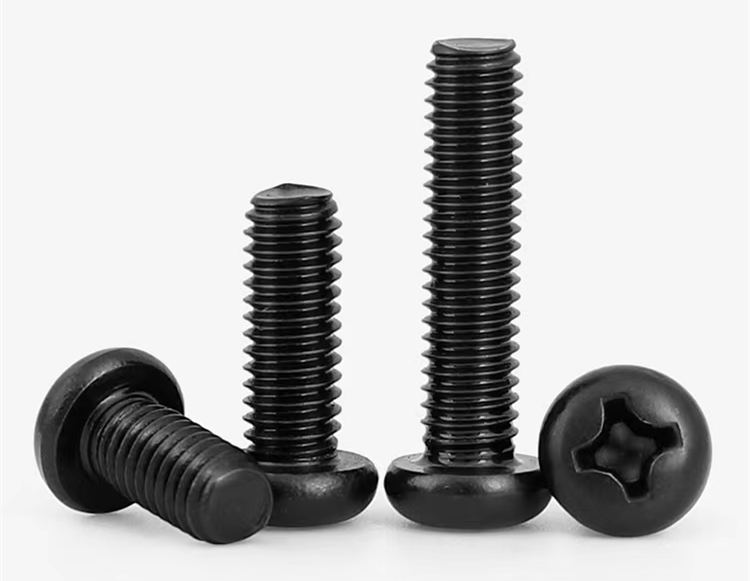
Electroplating
Electroplating is the process of using electrolysis to coat a layer of other metal films or alloy films on the metal surface. The purpose is to improve wear resistance, corrosion resistance, and aesthetics.
There are 2 types of black plating: black zinc plating and black nickel plating.
Black zinc plating is a kind of anti-oxidation processing of metal, which is suitable for hardware products. Zinc is chemically active and easily oxidized and darkened in the atmosphere. After galvanizing, it is treated with chromate to cover a chemical conversion film on the zinc, so that the active metal is in a passive state, which is the passivation treatment of the zinc layer. The passivation film can be divided into white passivation (white zinc), light blue (blue zinc), black passivation (black zinc), green passivation (green zinc), etc.
Usually, the process of electroplating black zinc is degreasing-cleaning-weak acid etching-electro-galvanizing-cleaning-passivation-cleaning-drying-sealing paint.
The black nickel coating obtained from the black nickel bath contains 40-60% nickel, 20-30% zinc, 10-15% sulfur, and about 10% organic matter. The black color is caused by the presence of black nickel sulfide in the coating due to the reduction of thiocyanate on the cathode to release sulfide ions. The copper bottom is added in the process, and the main function is to make nickel plating easier in the post process and to improve the corrosion resistance of the screw.
Electrophoresis
Electrophoresis refers to the phenomenon in which charged particles move toward electrodes of opposite electrical properties under the action of an electric field.
Black electrophoresis is the use of an external electric field to make particles such as pigments and resins suspended in the electrophoresis solution directionally migrate and deposit on the substrate surface of one of the electrodes. Electrophoretic black is widely used in the industry, taking the black process as an example: degreasing – cleaning – phosphating – electrophoretic paint – drying. It can be divided into anodic electrophoresis (resin becomes negative ions after ionization) and cathodic electrophoresis (resin becomes positive ions after electrophoresis). Compared with the painting process, it has better construction performance, less pollution and harm to the environment and its resistance to neutral salt spray is 300 hours or more, and the cost and corrosion resistance are similar to those of the dacromet process.
A battery holder is one or more compartments or chambers for holding a battery. A battery holder is either a plastic case with the shape of the housing moulded as a compartment or compartments that accepts a battery or batteries, or a separate plastic holder that is mounted with screws, eyelets, glue, double-sided tape, or other means. Battery holders may have a lid to retain and protect the batteries or may be sealed to prevent damage to circuitry and components from battery leakage. Coiled spring wire or flat tabs that press against the battery terminals are the two most common methods of making the electrical connection inside a holder. External connections on battery holders are usually made by contacts with pins, surface mount feet, solder lugs, or wire leads.
The coin cell battery holder is used to load the coin cell battery. It is generally welded on the PCB board, which is convenient for the button battery power supply. There are two installation methods for the button battery holder, one is the patch type and the other is the plug-in type.
How to identify the positive and negative poles of a coin cell battery holder?
Under normal circumstances, the side of the button battery with the “+” mark is the positive electrode, and the back is the negative electrode.How do I remove the battery from the coin cell holder?
The accessory with a button battery holder on the product is to facilitate the replacement of the button battery. By moving its metal shrapnel lightly, a careful search will reveal a way to remove the coin cell battery. Some coin cell battery holder designs may require a small sheet of insulating plastic to assist in removing the coin cell battery.
KENENG is an experienced button battery holder supplier and manufacturer, we can also carry out custom button battery holders services.
Advantages of KENENG Cell Battery Holder
1. ISO9001, ROHS, Dun & Bradsteet certifications.
2. More than 20 years manufacture.
3. Designated supplier of Medtronic and BBC.
4. Occupied 50% the China electronics market (Keyu series battery box and holder.)
5. The strict quality control system, 99% qualification rate.
6. Factory scale: 10000M2, 150 employees.
7. 15 years of foreign trade experience.
A battery refers to the part of a cup, tank or other container or composite container that holds an electrolyte solution and metal electrodes to generate electrical current and to convert chemical energy into electrical energy.
The performance parameters of the battery mainly include electromotive force, capacity, specific energy, and resistance. By using the battery as an energy source, people can get a long-term stable power supply and a current that is little affected by the outside world. The battery in modern society is simple in structure, easy to carry, easy to operate, not affected by external climate and temperature, and has stable performance, and is widely used in all aspects of modern social life.
AAA type battery
AAA batteries are also called 7 batteries. The volume of the 7th battery is smaller than that of the AA type (5th) battery. AAA batteries are generally used in remote controls, flashlights, etc., where the volume is limited, but the power consumption is not large.AA type battery
AA batteries are also called 5 batteries. AA-type batteries are very common and are widely used in electric shavers, electronic toys, digital devices, and more. Many AA-type rechargeable batteries are also used as battery packs.C type battery
The C-type battery is also called the No. 2 battery. The volume of the C-type battery is smaller than that of the D-type battery. Type C batteries are mostly used in flashlights and audio-visual equipment.D type battery
The D-type battery is also called 1 battery. D-type batteries are also very common and are widely used in electronic ignition equipment, flashlights, and so on.9V battery
9V batteries generally refer to laminated batteries. 9V batteries are generally used to power meters and measuring instruments. The battery capacity is small, the voltage is high, the internal chemical reaction is slow, the discharge current is small, and it can be used for a long time.
18650 battery
The 18650 battery has a large capacity per unit density and very good stability. Therefore, it is widely used in electronic fields, such as notebook computer batteries, portable instruments, industrial instruments, medical instruments, and so on.KENENG is a battey holder supplier. We can supply various types of battery holders. Including aa battery holder, 2 aa battery holder, 3 aa battery holder, 4 aa battery holder, 6 aa battery holder, 8 aa battery holder, 10 aa battery holder, 12 aa battery holder, aa battery case holder, battery box, aa battery box, 2 aa battery box, 4 aa battery box, aa wired battery box, etc.
Product Feature And Application
1. The perfect external power source for electronic DIY.
2. Holds four AA batteries.
3. Easy install, convenient to use.
4. High-quality plastic material.
5. The perfect external power source for single-chip microcomputer system, Arduino system, 2WD mobile robot, track-seeking car, RP5 tracked vehicle.
The marine mooring system refers to the use of equipment to fix the ship at the wharf or other places to limit its movement. So, how to select the best marine mooring equipment?
Choosing The Mooring Bollard
1. For the selection of mooring bollards, attention shall be paid to the requirements of the specification and size. Because of the different specifications and sizes of the ships, there are certain restrictions on the device.
2. Attention shall be paid to the restrictions on the installation position to avoid problems in the installation.
3. Attention shall be paid to the installation requirements, especially the power restrictions, to ensure that the installation of the device meets the stability requirements and ensures the effect.
4. It is necessary to pay attention to the functional requirements and functional limitations, especially the functional requirements of the cable and the limit of the bearing capacity, to ensure the stability of the device in use.

Choosing The Marine Mooring Chock
1. Corresponding types: Different types of products have different structural shapes. We need to choose the corresponding type chock to be able to use normally because of the appropriate structural shape.
2. Corresponding models: There are different models of the same type of mooring chocks, and there are certain differences in decoupling strands and materials between different models of it. Based on this situation, we need to select the corresponding model of products to be applicable.
3. High precision: Because the application has high requirements on the structure and quality of the mooring chock, it needs products with high precision, which will have better applicability because of the excellent comprehensive quality.
Choosing The Roller Fairlead
1. When selecting, it is necessary to see whether the surface of the device in contact with the cable is smooth. To avoid large abrasion of the cable during use, which may lead to the cable being easily broken and unable to be used for a long time.
2. Observe the steel parts except for the body and pin shaft. Generally speaking, there is no problem with the fairlead roller in the body and pin shaft structure. Therefore, it is suggested that when selecting the device, we should focus on other steel parts, especially paying attention to whether the steel parts other than the body and pin shaft have been galvanized or painted.
Selecting Marine Anchor
1. Bruce claw anchor is one of the most popular anchors among leisure rowers in North America. For most rowers, Bruce or delta is the best balance between price and performance.
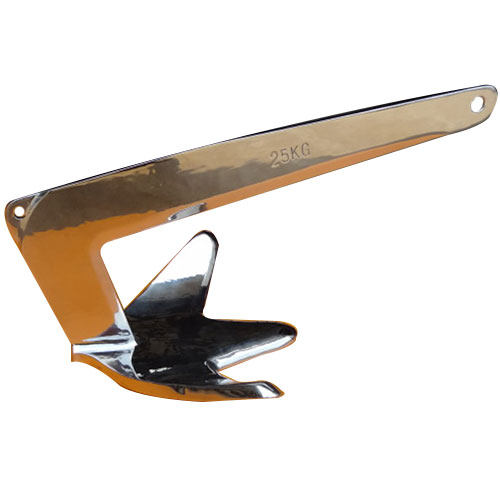
2. Plow anchors are suitable for most bow rollers. Fluke anchors are the perfect choice for auxiliary anchors or stern anchors. They perform well in sediment and can be easily stored on most bow rollers.
3. The head anchor of commercial ships mainly adopts rod less anchor, and the tail anchor sometimes adopts rod anchor and dovetail anchor.
4. There are many types of anchor materials, the most popular are low-carbon steel, high-strength steel, stainless steel, and aluminum. Most of the traditional steel anchors we are used to seeing in the market may be low-carbon steel or high-strength steel. When selecting ship anchors, in addition to the factors such as the length and weight of the ship, it is also necessary to carefully select the anchor materials.
Mooring is an integral part of cargo transportation. During the mooring period, the ship faces various natural forces and human forces. The mooring system refers to the use of equipment to fix the ship at the wharf or other places to limit its movement. There are five types of common mooring equipment that is essential.
Mooring Bollard
The mooring bollard is mooring ship equipment installed in the superstructure of the wharf. It is designed and selected according to the berth capacity and wharf structure type to meet the requirements of the safe, reliable, and convenient operation of ships leaving the wharf, berthing, shifting, and turning. It is composed of a shell, anchor rod, nut, washer, anchor plate, and column core packing. The most common types in the shipping industry are column mooring bollard and Cruciform Bollard.
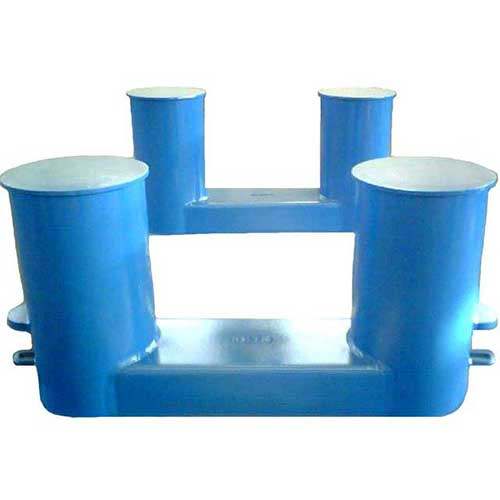
Marine Mooring Chock
Marine mooring chock is a closed-hole fairlead that is arranged on the bulwark and used to limit the leading out of the position of the cable. The basic shapes are round, oval, square, and closed mooring chock.
204 steel seamless steel pipe specified in GB 8162 is selected as the material of its body. It can also be bent from grade a steel plate specified in GB 712. 1Cr18Ni9Ti stainless steel plate specified in GB 4237 is selected as the stainless steel clad plate. At the intersection line of the body and the outer edge, the welding surface shall be clean and free of cracks, warpage, and skew. The cutting shall be straight and the sharp edge shall be removed. The stainless steel clad plate shall be flat with the body, and the weld shall be free of defects such as pores, cracks, and burrs.
Roller Fairlead
Roller fairlead is a fairlead composed of several independent rollers in parallel, which can be divided into the closed type and open type.
According to the number of rollers, the commonly used two roller, three roller, and four roller fairleads. It can export several cables at the same time, and its mass is smaller than that of the fairlead with rollers. It is mainly used on large and medium ships.
Rubber Fender
A rubber fender is installed on the wharf or ship to absorb the collision energy between the ship and the wharf or ship when berthing or mooring, and protect the ship and the wharf from damage.
It is divided into the following categories: cylindrical rubber fender, DA type rubber fender, D type super arch rubber fender, drum type rubber fender, DO type rubber fender, and V type rubber fender. They are different in reaction force, surface pressure, device maintenance, and convenience of use.
Marine Anchor
The main function of the marine anchor is to fix and stabilize the ship. After the anchor is pulled into the water bottom, it can provide berthing capacity for the ship.
It should be noted that this capability is not only accomplished by one anchor, but also by a long anchor chain.
There are many types of anchors, which can be divided into rod anchors (also known as naval anchors), Rodless anchors (commonly known as hall anchors and Speke anchors), high grip anchors (generally rod rotating claw anchors), and special anchors (commonly used for permanent mooring) according to different structural solutions and uses.