
The drilling simulator can mainly carry out simulation training of drilling technology, simulation training of drilling accident handling, and simulation training of well control technology. This article introduces 2 drilling simulators manufactured by Esimtech, including full-sized drilling simulator and portable srilling well control simulator, which are suitable for drilling simulator training in oil companies, oil schools, training centers, etc.
Full-sized Drilling Simulator
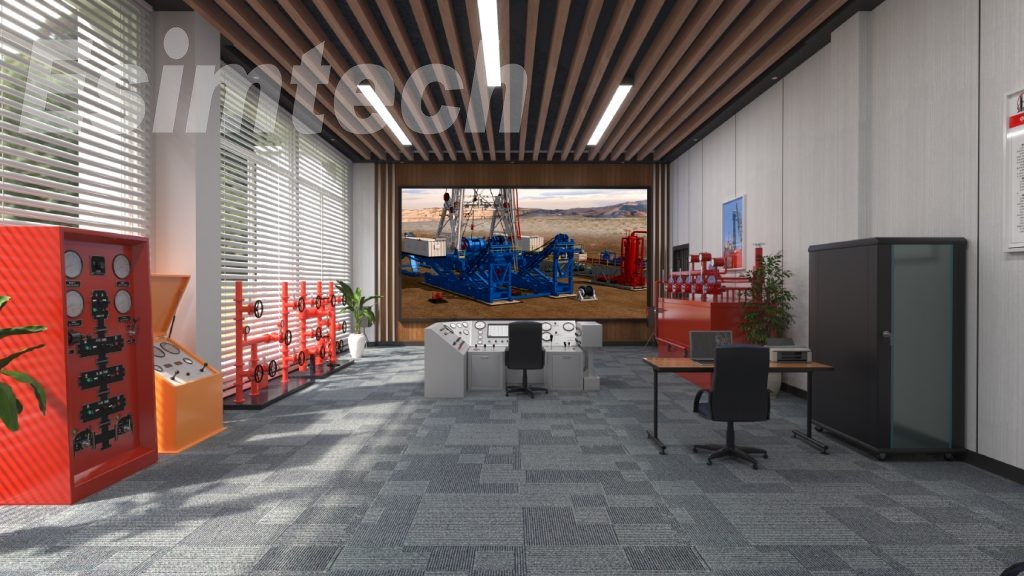
Full-sized Drilling Simulator training content:
1. Novice operation learning
2. Shut in the well
3. Well killing
4. The complex situation of underground accidents
5. Rig installation
Features of Full-sized Drilling Simulator equipment software:
1. Fully complies with IADC and IWCF well control specifications
2. Full 3D animation
3. Realistic live sound effects
4. The hardware and software structure conforms to the training characteristics: one-key start, one-key shutdown, remote monitoring
Portable Drilling Well Control Simulator

Training content of portable drilling well control simulator:
1. Shut-in operation
2. Killing operation
Features of portable drilling well control simulator equipment software:
1. The simulation training system complies with IADC and IWCF standards.
2. It is easy to carry, has complete functions, has real and reasonable well control process simulation, and can flexibly set various drilling parameters, such as drilling tool structure, well body structure, formation parameters, equipment parameters, etc.
3. Three-dimensional, interactive animation.
4 Fully intelligent scoring, fair and just assessment.
5 Fully adopt industrial grade components, the system is stable and reliable.
Esimtech produces training simulators for various types of work in the oil and gas industry. After more than 20 years of unremitting efforts, it has successively developed a number of petroleum engineering training simulation systems represented by oil drilling simulators.
With the well intervention simulator to carry out the training of well intervention operation and well intervention snubbing operation, many difficulties in the training work can be solved. Below we will introduce several well intervention simulators produced by Esimtech in detail.
What is Well Intervention?
Well intervention refers to an operation of oil drilling and subsequent oil well maintenance. It is a maintenance and maintenance measure taken to ensure the smooth use of oil wells.
What is Well Intervention Snubbing Operation?
Using special well intervention equipment, under the condition of pressure on the wellhead of oil, gas, and water wells, it is a downhole operation technology to implement pipe and rod tripping, wellbore repair, and production stimulation measures.
What is the Significance of the Well Intervention Snubbing Operation?
Protect oil and gas formations
Protective sleeve
Improve single-well production
Ensure construction safety and environmental protection
The well intervention snubbing operation solves the technical problems in the well intervention process of oilfield development and is a leap forward in the well intervention technology.
5 Types of Well Intervention Simulator
Snubbing Simulator (MR)
Snubbing simulator (MR) combines full-size drilling snubbing simulator with VR technology. Enable trainees to complete training items such as running and pulling tubing, tools, etc. in a training environment that combines virtual and reality, and master basic forced tripping operations and common forced tripping technical processes.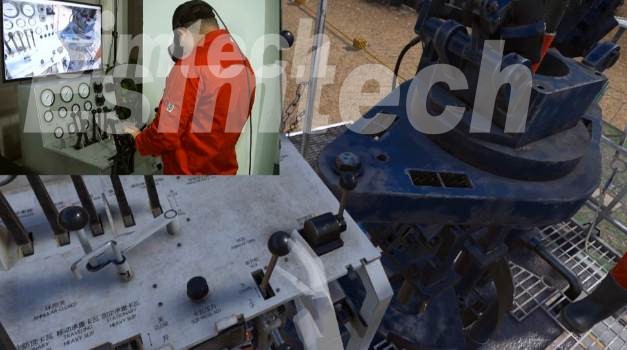
ESIM-FCT1L Full Size Coiled Tubing Simulator
ESIM-FCT1L Full Size Coiled Tubing Simulator is equipped with an operation console and displays the operation scene through 3D animation. And you can freely set related parameters and operation sequences. The simulator is capable of training on well intervention, well logging, stimulation, drilling, accident handling, etc.
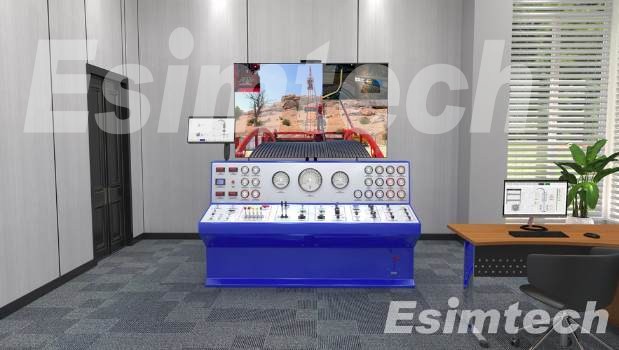
ESIM-PSS2 Portable Snubbing Simulator
The parameter settings and panel layout of the ESIM-PSS2 Portable Snubbing Simulator are the same as those of the actual equipment, similar to the device on-site.
Through the operation process designed according to the actual program, 3D interactive animation, and realistic sound simulation, it provides training for forced tripping technicians in oilfields.
ESIM-FSS2 Full Size Snubbing Simulator
ESIM-FSS2 Full Size Snubbing Simulator presents downhole tool movement through 3D animation and provides training operations such as pulling and running tubing, tools, etc.
The Snubbing Simulator combines petroleum engineering technology, computer technology, virtual reality technology, and realistic environmental sound effects to enable trainees to be trained in an immersive environment.
ESIM-PCT1 Portable Coiled Tubing Simulator
The portable coiled tubing simulator provides training items such as drilling bridge plug, sand-washing, fluid flowing by gas-lift, problem treatment, etc. It is mainly used to train new staff, coiled tubing operators, coiled tubing operation team leaders, and more.
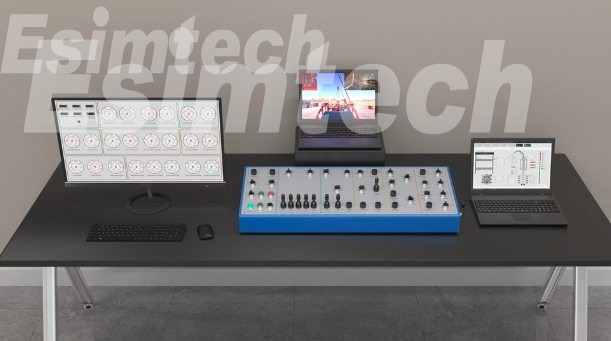
The simulator can solve basic methods of operating coiled tubing, common technology processes of coiled tubing operation, common troubles and problems by combining accurate mathematical models and physical models, highly realistic 3D scene display, computer network technology, and customized software and hardware treatment, etc. and other issues.
Esimtech has developed relevant training simulation systems for petroleum engineering industries such as snubbing operations, drilling, well control, logging, oil production, gas production, downhole operations, oil and gas gathering and transportation, fracturing and acidizing, drilling rig installation, and coiled tubing. You view more knowledge on the articles of what is well intervention simulator.
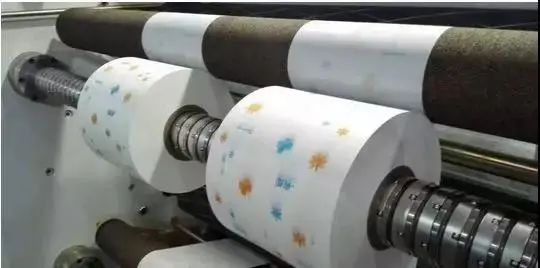
The tension control system plays a very important role in the production of coil materials, such as high-speed gravure printing machine, laminating machine, coating machine, slitting machine and other equipment, are basically equipped with advanced tension control system, which mainly controls the tension of paper, plastic film and other reel materials. The tension control plays an important role in keeping the tension constant. In the production process, if the tension is too large, it will lead to tensile deformation of the material. If the tension is too small, the stress deformation between the material layers will easily occur, resulting in irregular winding, which will have a direct impact on the quality of the final product.
In order to ensure the smooth operation of the tension control system and maintain the optimal tension of the coil material, it is necessary to fully understand the tension control system. This article mainly tells the control modes, composition and working principle of the tension control system.
Control Modes Of Tension Control System
The main control modes of tension control system include direct tension control and indirect tension control.
Direct tension control is also called feedback control. It adopts tension sensor to detect the actual tension, and then converts the measured value into feedback signal and compares it with the preset tension. When there is a deviation between the two, the tension controller gives the corresponding control of the tension control system to match the actual tension with the preset tension, thus forming a tension closed-loop system. Direct tension control does not need to consider various adjustments and compensations, and can eliminate steady-state errors with high control accuracy.
Indirect tension control, also known as compensation control, can adjust and compensate the parameters that affect the tension stability to avoid the tension changes that will occur and indirectly maintain the tension stability. Compared with direct tension control, indirect tension control has poor randomness and low control accuracy.
Structure And Working Principle Of Tension Control System
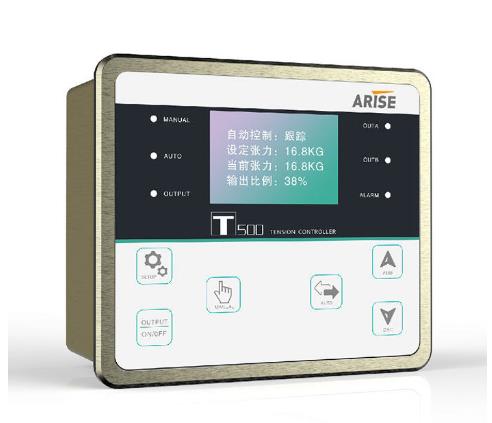
The tension control system is mainly composed of three parts, which includes unwinding tension control system, traction tension control system and winding tension control system. The constant tension control of the coil material is realized through tension sensor, tension controller, frequency conversion controller, magnetic powder brake and other components.
1. Unwinding tension control system
Working principle
The tension sensor detects the actual value of the unwinding tension and feeds it back to the tension controller. Compared with the preset value of the unwinding tension in the tension controller, the deviation between the two is calculated by PID and the control voltage is output to control the resistance moment of the magnetic powder brake acting on the unwinding shaft, so as to achieve the purpose of adjusting the unwinding tension.
2. Traction tension control system
Working principle
In the production process, when the traction tension of the coil material changes, the swing roller will make corresponding swing amount. At this time, the high-precision potentiometer will indirectly measure the change of the traction tension, and then feed back the corresponding signal to the traction roller driver. After the PID adjustment, the operation speed of the traction roller will be controlled. The swing amount of the swing roller will be adjusted by changing the pressure of the low-friction cylinder to keep it stable at the set position, that is, the traction tension control will be realized.
3.Winding tension control system
Working principle
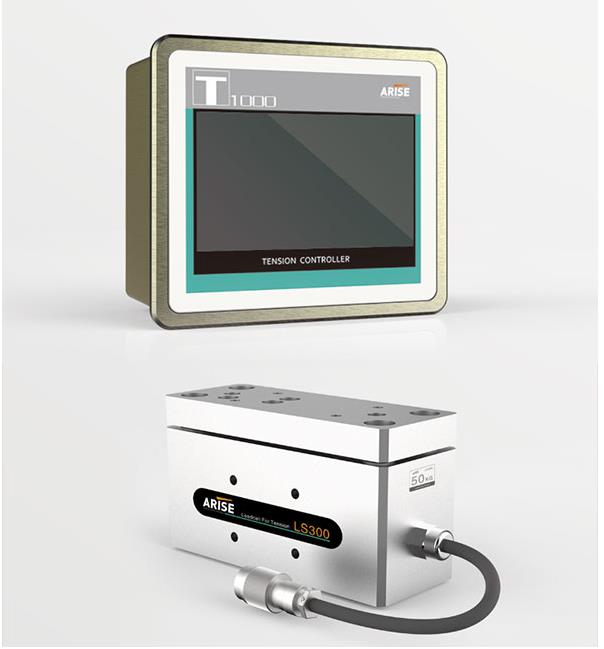
The tension control system detects the actual value of the winding tension through the tension sensor, and then feeds it back to the winding web tension controller. Compared with the preset value, the deviation between the two is calculated by PID and the control voltage is output to the winding motor driver to adjust the running speed of the winding motor to achieve constant tension control. In the winding tension control system of some equipment, the taper tension control system is often added, which can make the coil material in the state of tight inside and loose outside during the winding process, so as to prevent the slipping among layers of the coil materials and improve the tension stability of the subsequent procedures.
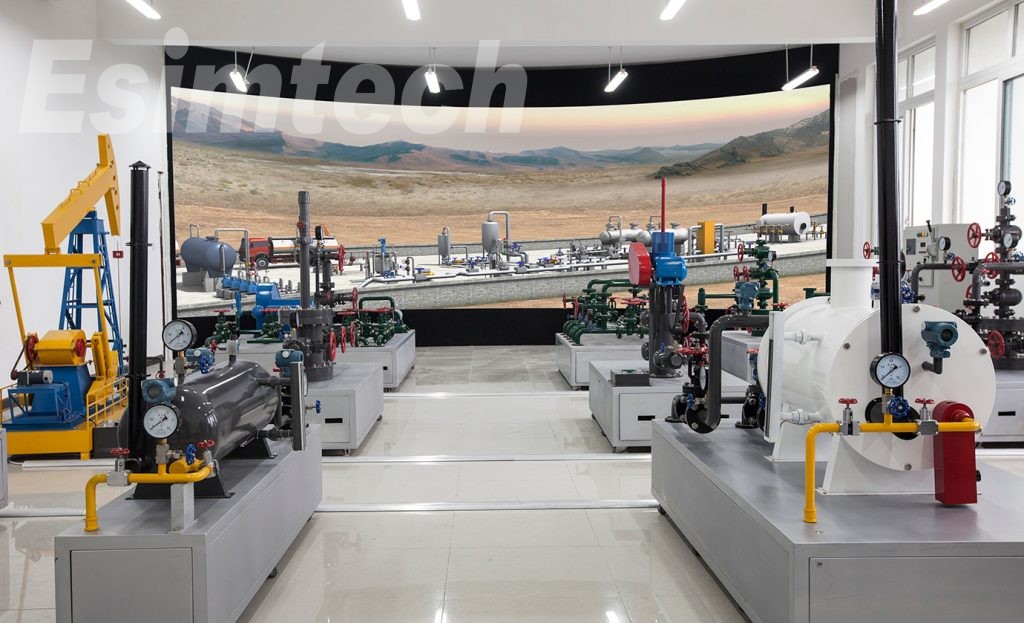
Oil and gas gathering and transportation simulation system is a training system with advanced technology and complete functions in China, which can meet the actual needs of oilfield training. It has the ability to conduct simulation training for gathering oil and gas & oil and gas transportation.

Advantages of Oil and Gas Storage and Transportation Simulator
1. The oil and gas storage and transportation simulator is the product of a collection of petroleum engineering, oil and gas storage and transportation and computer technology, computer simulation technology, and virtual reality technology.
2. Based on the national occupational technical standards and occupational skill appraisal standards of various types of work in the field of oil and gas gathering and transportation, and combined with the actual situation on site. Using the electronic sand table, process board, and touch screen as the medium, the application of computer, virtual reality, and other technical means. Real simulation of the entire process of oil and gas storage and transportation from the wellhead to the combined station, to the oil depot, and then to the oil and gas export.
3. It can simulate the collection of oil well products, gas-liquid separation, crude oil dehydration, crude oil stabilization, sewage treatment, oil and gas storage and transportation, and other main process links, process flow, and process equipment.
4. The system consists of a combined station, long-distance crude oil transportation, natural gas pressurized and sub-transport, LNG receiving station, refined oil depot, and supporting software.
The appearance of each operation console in the system is basically the same as that of the real equipment on site.
The layout, operation mode and parameter display of various equipment panels are basically consistent with the on-site situation.
The hardware system is designed in accordance with industrial standards, and the data acquisition and control system is composed of PLC, which ensures the reliability of the equipment to the greatest extent.
The system input cost and maintenance cost are low, and there is no security risk.
5. The system calculates the pressure, flow, and temperature of the fluid in the pipeline in real-time. Advanced mathematical models make training more realistic in the field. The process status is displayed on the large-screen LCD TV, making the whole process clear and easy to understand, which can reduce the training time of the trainees and allow the trainees to have a deeper understanding.
Training Content of the Oil and Gas Storage and Transportation Simulator?
1. The simulation training system can realize the operation simulation training for the technicians of the five major parts of the joint station, the long-distance crude oil pipeline pumping station, the pressurized sub-transportation station, the oil depot, and the LNG terminal.
2. It enables students to understand the internal structure, principle, and usage of various oil and gas gathering and transportation equipment, be familiar with the typical stations and processes of this part and be able to deal with common accidents on site.
Characteristics of Oil and Gas Storage and Transportation Simulator
1. The appearance and structure of the field equipment and facilities are highly simulated, and are made according to a certain scale.
2. Simulation of the operation of oil and gas gathering and transportation system can be realized.
3. The electronic sand table displays the equipment pipeline and layout of each link in the oil and gas gathering and transportation process.
4. The three-dimensional animation shows the structure and working principle of the main equipment in the oil and gas gathering and transportation process.
5. Use the touch screen and virtual reality technology to meet real process requirements.
Tension control refers to the ability to control the tension of raw materials when they are transported on the equipment. The tension control of slitting machine must be effective for any running speed, including the acceleration speed, deceleration speed and uniform speed of the machine. Even in case of emergency shutdown, it shall be able to ensure that the cut raw materials are not scratched or damaged.

Why Tension Control Is ImportantIn The Slitting Machine
With the increasing degree of mechanization, the requirements for the efficiency of winding operation are also higher and higher. When the slitting machine is applied to the slitting operation of film, tape and paper, the large reel of the whole roll can be divided into several small reels according to different requirements to meet the needs of different occasions. The tension control system is the core part of the slitting machine.
The tension control of the slitting machine is basically manual tension control and automatic tension control. Manual tension control is to control the tension by adjusting the manual power supply device by the operator when the coil diameter changes to a certain stage during the winding or unwinding process.
Full-automatic tension control is to measure the actual tension value of the material belt directly by the tension sensor, and then convert the tension data into a tension signal and feed it back to the tension controller. By comparing this signal with the preset tension value of the controller, the control signal is calculated. The automatic control execution unit makes the actual tension value equal to the preset tension value, so as to achieve the purpose of stabilizing the tension.
The stability of tension control is directly related to the quality of slitting products. If the tension is insufficient, the raw material will loose or drift during operation, and the finished material will wrinkle after slitting and rewinding. If the tension is too large, the raw material is easy to be broken, resulting in more broken ends of the finished material after slitting and rewinding.
Tension Control Of The Slitting Machine
The formation of tension can be realized in many ways, but its basic principles are consistent. During the startup process, the linear speed of the winding coil is greater than the linear speed of the unwinding coil to generate a certain tension in the winding roll. When the winding reaches the appropriate tension required by us, timely adjust the power mechanism to stabilize the linear speed of the winding coil and the unwinding coil, so that the raw material can operate stably under this tension. The tension control system is to meet the tension stability of the whole machine.
Tension Control Detection System Of The Slitting Machine
1. Tension sensor detection
It is a direct detection of tension, which is closely combined with machinery, and is equipped with a detection method of moving parts. Usually two sensors are used in pairs, and they are installed on the end shafts on both sides of the detection guide roller. By detecting the applied load on both sides of the guide roller, the material belt makes the tension sensor sensitive element produce displacement or deformation, thus detecting the actual tension value, converting this tension data into a tension signal to feed back to the tension controller.
2. Indirect tension detection system of floating roll
A set of floating roll is installed in front of the tracking roll. The position of the floating roll is detected by a potentiometer. The tension control method is to maintain the constant tension by maintaining the position of the floating roll unchanged.
3. Magnetic particle clutch
Magnetic particle clutch is used to control the rotational torque of the input take-up roll to achieve tension control: the magnetic particle clutch is composed of the driving part and the driven part, and is connected with the take-up roll through the universal coupling and other transmission mechanisms, and the middle is filled with fine iron particles as the torque transmission medium.
A magnetic field is formed by applying a certain current to the excitation coil, and the magnetic particle is magnetized. The magnetized magnetic particles attract each other and form a chain arrangement. When the driving part rotates at a constant speed, the coupling force between the magnetic particles is destroyed and a circumferential tangential force is formed. The product of the tangential force and the radius of the magnetic particle circle is the rotational torque of the driven part for winding up, so as to realize the coupling of the output torque from the driving part to the driven part in continuous rotation, thus achieving the purpose of tension control.
4. The slitting & unwinding capacity and speed tension detection system
It mainly uses magnetic particle brake to control the unwinding speed. Its working principle is that the magnetic particle brake is equipped with a coupling, as well as input parts and output parts with magnetic coils. Below the magnetic coil is an annular groove, and below the groove is an annular rotor, namely the output part. The annular groove is located in the center of the output part, and the groove is filled with magnetic powder.
When there is excitation current in the magnetic coil, the coil will generate magnetic flux to make the magnetic particles arranged along the magnetic field direction, which will generate damping between the input part and the output part and transfer the torque. If the tension and speed applied on the aluminum foil are increased or decreased, the tension and speed can be effectively controlled by changing the magnitude of the excitation current, or the current or voltage value applied by the amplifier to the coupling coil.