
Emergency exercise simulation training system developed by Esimtech is a set of virtual simulation solutions for typical well drilling accident emergencies. It can enable relevant operators or learners to receive training on blowouts, explosions, hydrogen sulfide leakage, and other accidents during drilling, and enhance safety awareness and emergency response, handling, and escape capabilities.
Emergency Exercise (VR)
The emergency exercise (VR) is developed based on the emergency drill software platform. The purpose is to train and test drilling emergency drills.
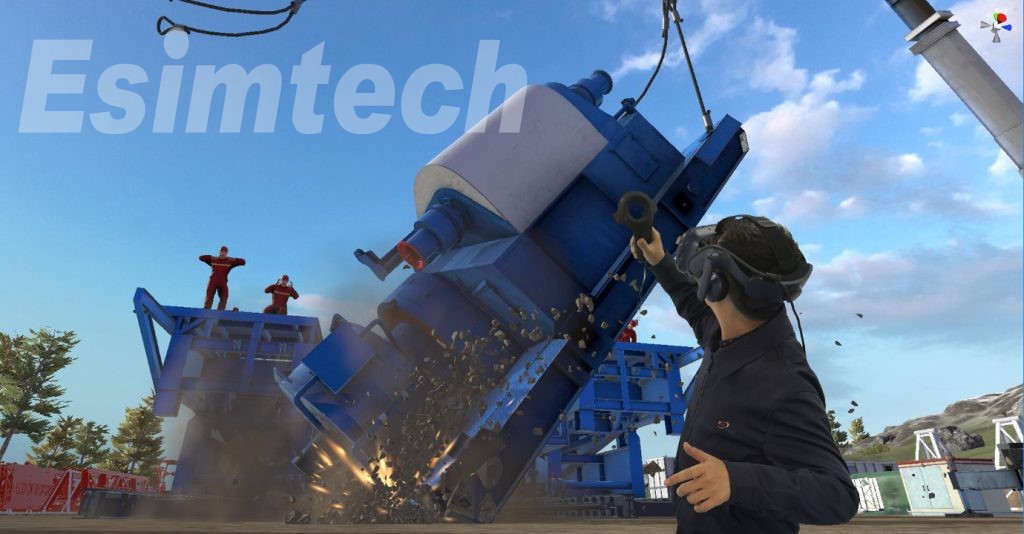
Trainees can have realistic VR interactions and an immersive experience. Through the super simulation system and human-computer interaction, students can get real feedback on the environment during the operation process. Through the training and testing of this system, the trainees can cultivate their own psychological quality and complete the training in emergency response drills and emergency escape.
Drilling Emergency Practice Training Platform
The drilling emergency training platform can make the trainees feel the real situation as much as possible, and make the trainees deeply impressed with the emergency situation handling process in the oil industry. In this way, when students encounter real blowouts, explosions, and hydrogen sulfide leakage accidents, it will help them to calmly take correct emergency measures.
The training items of the training system include the above-mentioned emergency treatment and escape training when blowout is out of control, emergency treatment and escape training in case of fire and explosion, and emergency treatment and escape training in case of hydrogen sulfide leakage and poisoning.
Drilling Emergency Exercise Simulation Training System
The drilling emergency exercise simulation training system can realize emergency treatment and training for typical drilling accidents. The R&D and manufacturing of the simulation training system combine technologies such as 3D simulation, 3D interaction, and network communication. Through 3D technology, the system can simulate the drilling site environment, drilling equipment and facilities, and operators, and show the actual occurrence and progress of accidents. It allows students to perform 3D interactive operations in it to achieve the purpose of training.
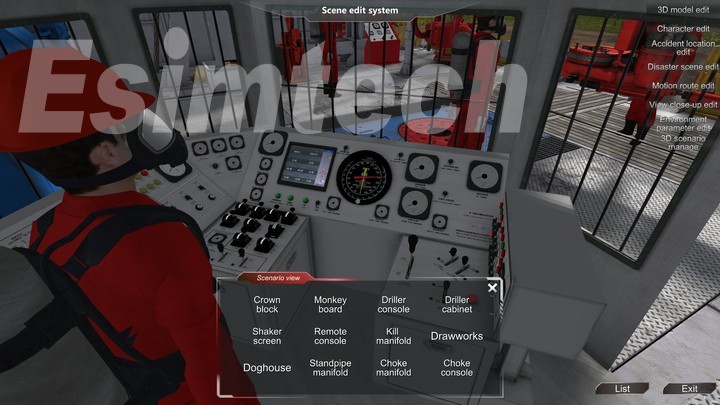
The training system not only enables trainees to receive drilling accident training but also evaluates trainees’ completion of training and displays problems and errors in trainees' operations.
Drilling and well control safety technology directly affects the development of oilfield companies. If the well control safety technology cannot be guaranteed, it will seriously affect the safety of life and property.
Application of well control safety technology in drilling
In drilling work, due to the influence of exploration well depth, long period, complex formation, high formation pressure, and high hydrogen sulfide content, well control safety technology may encounter many difficulties in the drilling process.
First, when drilling in high-sulfur areas, the combination of hydrogen sulfide and well control issues presents a significant safety risk in well control technology. This particular operating environment brings difficulties to materials or tools such as wellhead equipment, casing, and tubing when conducting exploration operations in high-sulfur areas. In the event of a blowout or leakage, it is very easy to cause serious poisoning of hydrogen sulfide.
Second, there is the difficulty of degassing in well control safety technology. When drilling ultra-high pressure oil and gas wells, it is generally necessary to increase the drilling concentration to balance the formation pressure so that the drilling fluid system can develop stably. Degassing in high density and high viscosity drilling fluids is difficult.
Third, the pressure bearing capacity of drilling equipment is limited.
Ways to strengthen well control safety technology
Strictly standardize the design of well control safety technology
Drilling and well control safety technology should be designed in strict accordance with the standards so that the drilling and well control safety technology develops in the direction of standardization and management. In installing equipment, we must adhere to the principles of high standards and strict requirements to eliminate potential safety hazards in the installation of equipment, which is in line with the design of drilling and well control safety technology.
Improve the professional quality of well control personnel
In drilling work, well control safety work is the most basic work. Because employees’ well control safety knowledge is essential, educating and training employees’ safety well control knowledge is a major event in well control work. The company should formulate a practical training plan so as to improve the safety awareness of well control personnel. It is necessary to strengthen emergency drills, and through actual combat drills, employees’ awareness of drilling and well control can be greatly improved.
To strengthen the special inspection of drilling and well control
In daily life, to constantly check the drilling equipment, it is also necessary to carry out special inspections of the drilling and well control equipment. For problems found in the inspection, the company shall arrange technical personnel to deal with the problems in a timely manner.
Improve and perfect well control safety technology
Improve the dynamic control capability of well control equipment
In order to ensure the safety of well control technology, firstly, it is necessary to continuously improve the structure of the choke valve, improve the strength, precise control ability, and anti-erosion ability of the choke valve so that the choke pressure can be easily adjusted, thereby improving the downstream of the choke valve’s impact resistance. Second, to develop a new multi-stage throttling system.
Carry out research on well control technology to solve hidden dangers in well control equipment
Carry out sulfur prevention work and do an excellent job in the protection of hydrogen sulfide
In view of the sulfur content in different regions, each inspection area shall take corresponding measures in terms of sulfur-resistant equipment and technology to ensure the safety of well control technology.
When conducting exploration in high-sulfur areas, artificial ignition should be avoided, and an all-weather remote control ignition device should be installed. In areas with high sulfur content, formulate standards for hydrogen sulfide protection and monitoring equipment.
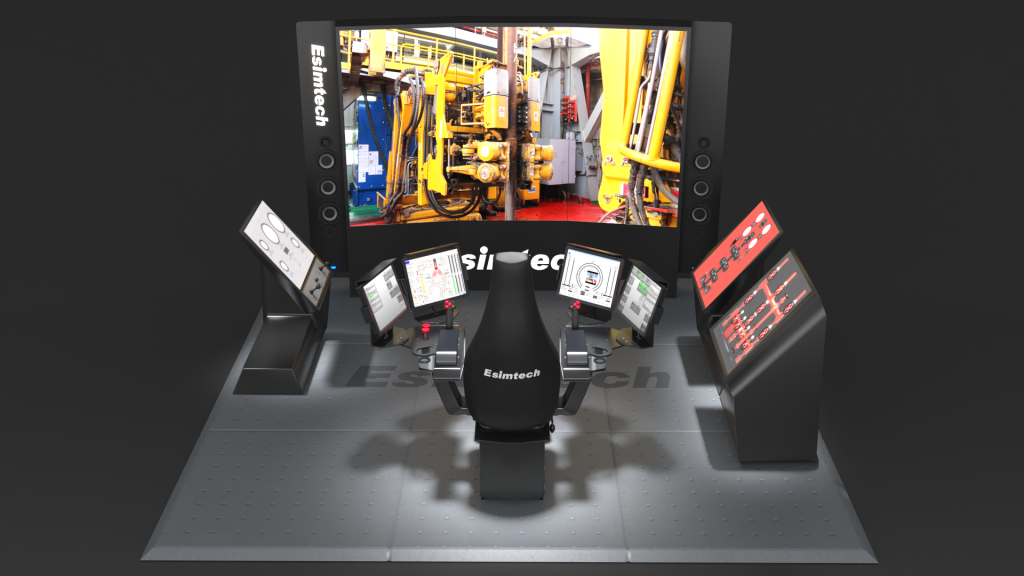
In the drilling and well control safety work, we can use the drilling and well control simulator to conduct simulation training among the staff in advance to strengthen the safety control. We offer portable drilling well control simulation, cyberchair drilling simulator, top drive simulator, drilling simulation training system, land rig installation simulator, etc. It can highly simulate the real on-site equipment, panel layouts, operation methods, etc. It can produce visual effects similar to the scene, coupled with realistic sound effects of live equipment, giving people a sense of immersion and realism.
This article will discuss various risk factors that may exist in the process of downhole operations. The problems and deficiencies in the safety management of downhole operations are analyzed, and corresponding solutions are proposed for these problems.
Suppose a safety accident occurs in the downhole operation. In that case, it will cause serious economic losses to the enterprise and the country, and the personal safety of the relevant personnel will be affected. Therefore, it is very important to ensure downhole operations’ safety, stability, and efficiency. We need to pay attention to safety management in the drilling and production process.
We should try to avoid the occurrence of unsafe downhole operations and safety accidents and strive to control the occurrence of downhole operation accidents to zero.
Inadequate Safety of Downhole Operations
Downhole operation is a technological method to guarantee the regular manufacturing of oil and also water wells in the process of oilfield expedition and growth. Mainly include oil and water well maintenance, oil and water well overhaul, reservoir reconstruction, and oil testing.
During the long-term production process of oil and water wells, due to the interference of various underground liquids and gases and the action of gas flow, the well conditions will gradually deteriorate, corrode, eccentric wear, and various types of failures will occur, resulting in oil and water wells not producing normally. The downhole repair of oil and water wells with problems and failures to ensure normal oil and water well work, and a series of measures implemented to relieve oil and water well failures, restore or improve their production capacity in the process of repairing various downhole failures. The process is downhole work.
There are many construction points in underground operations involving various constructions, and the hidden dangers of safety are also more complicated. Due to the influence of factors such as humans, environment, equipment, and facilities, underground operations are highly dangerous.
Unsafe underground operation mainly refers to the forcible operation of underground workers without excluding unsafe factors such as unsafe conditions and unsafe behaviors. Unsafe behavior mainly refers to operating errors, ignoring safety, ignoring warnings, using unsafe equipment, venturing into dangerous places, etc.
Unsafe factors caused by machinery, facilities, and humans should be avoided as much as possible. Underground operators must eliminate unsafe operations, master certain safety knowledge, and at the same time strengthen safety awareness, so as to avoid unsafe operations and safety accidents to the greatest extent and ensure safe production.

Problems Existing in the Safety of Downhole Operation
1. Lack of safety awareness of downhole operators
Safety knowledge means that people always keep in mind the importance of safety and know what to do when faced with danger. When working at ordinary times, know how to operate and know what preventive measures, treatment measures, or emergency rescue measures to take in emergencies. However, the safety awareness of underground operators is often weak.
2. Inadequate safety management system
The underground operation sites are often in relatively remote areas, the construction environment is relatively poor, and there are great difficulties in the safety management of the construction site. The production tasks are tight, the construction personnel is many, the workload is large, the work intensity is high, and the production links are many, which leads to the lack of serious implementation of the safety management system.
3. Incomplete standardization scheme for downhole operation safety
A comprehensive safety management system should be established. In addition, a corresponding safety standardization scheme is established for each link in the production process of underground operations to ensure safe production, and the details must be sufficiently standardized.
Actions to be Taken:
1. Strengthen the safety awareness education of underground operators.
2. Improve the safety management system.
3. Improve the safety standardization plan for underground operations.
4. Use simulation systems. The downhole operation simulators can give students an immersive experience through the 3D animation synchronized with the operating conditions. And it can use mathematical models to simulate various working conditions and parameters in petroleum engineering operations and strive to achieve the same effect as actual drilling operations. In this way, students can intuitively experience and quickly master the relevant knowledge and skills of fracturing and acidizing production.
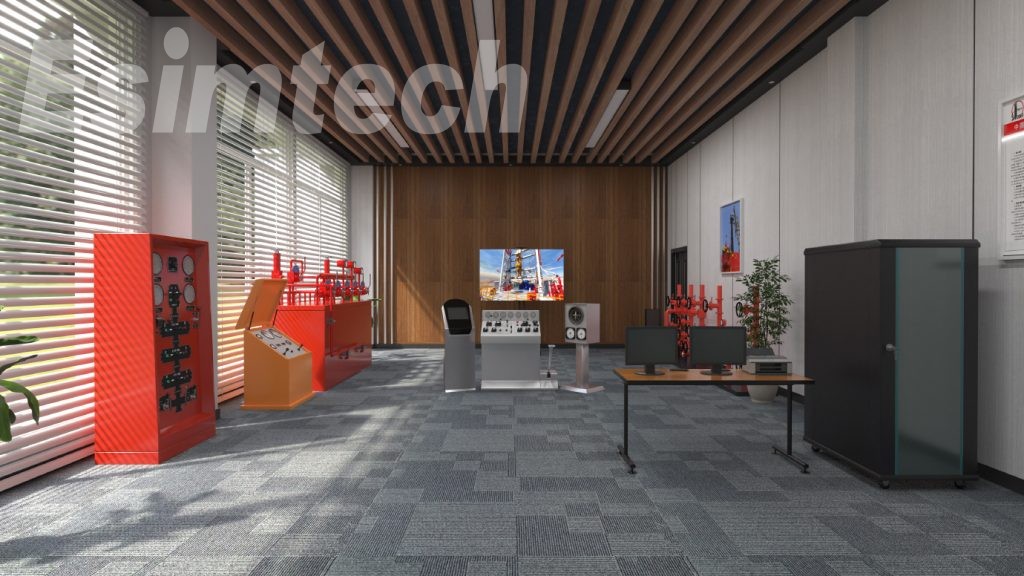
Oil drilling well control is an essential link in the process of oil and natural gas exploration and development and is the premise and guarantee for the safe production of oil and natural gas. Every effort must be made to ensure the smooth progress of construction and the safety of personnel on-site. Therefore, we must control the oil drilling well control link. From online and offline, both theory and practice need to be learned and mastered in all aspects. This article will introduce two kinds of drilling and well control simulation training systems developed and manufactured by Esimtech.
Full-scale drilling simulation training system

All hardware systems of the full-scale drilling simulation training system highly simulate real equipment on site. Various panel layouts, operation methods, parameter display methods, etc., in the simulation system, are consistent with the production site. The system can produce visual effects similar to the scene by projecting the three-dimensional graphics synchronized with the operating conditions onto the front screen. Combined with realistic sound effects of live equipment, it gives people an immersive sense of immersion and realism.
The system is based on advanced computer industrial control technology, artificial intelligence technology, scientific visualization technology, virtual reality technology, and advanced network technology, combined with strict simulation of the actual process of drilling engineering, using high-reliability classical physical and mathematical models based on real on-site well conditions and well history information provides users with various training operations such as tripping, drilling, well control, equipment fault detection, and handling of drilling accidents and complex situations.
The system highly simulates well conditions and equipment operations, improves the flexibility of trainers’ operations, and greatly improves the training efficiency and effectiveness of trainers.
The operation items involved in the training system include five modules: tripping module, drilling module, downhole accident handling module, well shut-in operation, and well-cementing operation.
Portable Drilling Well Control Simulation Training System

Features of Portable Drilling Well Control Simulation Training System:
The drilling well control simulation training system is easy to carry and has perfect functions.
The system is compliant with IADC and IWCF standards.
Various drilling parameters can be flexibly set, such as drilling tool structure, formation parameters, equipment parameters, etc., making training more flexible and targeted.
The software system adopts an unordered architecture, which can realistically simulate various operations of the drilling rig, making the system closer to reality.
Using virtual reality technology to construct a realistic perception environment, using three-dimensional animation synchronized with the operating conditions, combined with simulated on-site sound effects, gives people an immersive feeling.
The operation items involved in the training system include shut-in operations and well-killing operations.
Due to the limitations of traditional training, we have been paying attention to the development of online training for petroleum occupations and are committed to helping major drilling training centres or petroleum colleges complete training tasks under different conditions. Esimtech has developed an online drilling simulation training system by conducting research on online training. At the same time, through an in-depth understanding of the training needs of IADC and IWCF, we are committed to creating a fully functional online drilling simulation training system.
A drilling simulator is a new training method developed through the concept of virtual manufacturing technology, based on modern computer control technology, computer graphics technology, computer simulation technology, and computer network technology, combined with the actual technology of drilling engineering. It changes the traditional drilling training method and can provide users with the simulation of the operation process of drilling, tripping, well control, drilling accidents and complex situation processing. The training assessment provides a teacher scoring system, which solves the technical problems that cannot be solved objectively in the traditional training process.
The drilling simulator cooperates with three-dimensional interactive equipment through VR virtual reality technology, which can simulate the well site environment, equipment and facilities, and workflow, as well as the formation structure, wellbore trajectory, drilling targets and other objects that are prone to deviations when observed with the naked eye. The display effect is accurate, intuitive and diverse.
Advantages of Drilling Simulator
1. Compared with traditional training methods, it is not limited by time and space.
2. It is convenient for teachers to carry out one-to-many training
3. Support personal practice and review after class
With the support of virtual reality technology, the ideal virtual environment can make the trainees in the realistic environment of the training project objects, and it is difficult to distinguish the true from the false. Moreover, virtual reality technology can carry out personalized education and training according to the foundation and ability of different students. This is not possible with traditional training methods.