
Enzyme-Linked Immunosorbent Assay (ELISA) is a powerful technique in life sciences, enabling researchers to detect and quantify various substances, such as proteins, antibodies, and hormones. To fully leverage this technique, incorporating an ELISA reader into your workflow is essential. This guide explores the key aspects of using an ELISA reader to achieve accurate and efficient results.

What is an ELISA Reader?
Before diving into the specifics of using an ELISA reader, it's important to understand the fundamental principles of ELISA itself. ELISA readers are specialized instruments designed to measure the optical density of reactions occurring in microplate wells. These readers work on the principle of absorbance, where the amount of light absorbed by a sample is directly proportional to the concentration of the target molecule.

ELISA is a widely used assay for detecting and quantifying proteins, antibodies, or antigens in a sample. The results are obtained through a series of carefully executed steps, including incubation, washing, and the addition of specific reagents. To ensure reliable outcomes, following a systematic approach is crucial.
How to Use an ELISA Reader: A Step-by-Step Guide
Prepare Your Samples:
Start by collecting and preparing your samples according to established protocols.
Ensure uniformity in sample preparation, including proper dilutions to stay within the assay's linear range.
Plate Loading:
Accurately dispense your samples into the microplate wells.
Include appropriate controls, such as standards and blanks, to establish a reliable reference for measurements.
Incubation:
Allow the reaction to proceed by placing the microplate in an incubator.
Follow recommended incubation times and temperatures to promote optimal binding.
Washing:
Thoroughly wash the microplate wells to remove unbound substances.
Consistent and meticulous washing is vital to minimize background noise and enhance the signal-to-noise ratio.
Add Detection Reagents:
Introduce detection reagents, such as enzyme-linked antibodies or substrates, to generate a measurable signal.
Adhere to recommended concentrations and incubation times for these reagents.
Reading the Plate:
Insert the microplate into the ELISA reader.
Select the appropriate detection wavelength and set the reader to measure absorbance.
Record the readings for each well, ensuring alignment with your assay’s calibration curve.
Data Analysis:
Use the recorded absorbance values to calculate concentrations based on your standard curve.
Apply statistical analysis to validate the reliability of your results.
Tips for Optimal Performance When Using an ELISA Reader
Calibration:
Regularly calibrate your ELISA reader using standards to maintain accuracy.
Follow the manufacturer's guidelines for calibration procedures.
Maintenance:
Keep your ELISA reader clean and well-maintained to prevent contamination.
Regularly inspect and clean the optics and ensure the instrument is functioning correctly.
Quality Control:
Include quality control samples in each assay to monitor the consistency of your results.
Promptly investigate and address any deviations to identify potential sources of error.
Data Documentation:
Maintain comprehensive records of your experimental setup, reagent lots, and instrument settings.
Document any deviations from the standard protocol.
Conclusion
Mastering the use of an ELISA reader is a skill that develops with practice and understanding. By following these steps and paying close attention to detail, researchers can fully harness the potential of ELISA readers, ensuring the accuracy and efficiency of their experiments. As technology advances, becoming proficient in using instruments like the ELISA reader remains crucial to driving scientific discovery and innovation.
Clinical trials are a pivotal phase in the development of new medical treatments, serving as the bridge between laboratory research and real-world patient care. Among the many tools that facilitate this transition, ELISA (Enzyme-Linked Immunosorbent Assay) microplate readers are essential. These devices are invaluable in drug and therapy development, enabling researchers to measure the concentration of specific substances in samples—such as blood—providing critical data on patient progress and the effectiveness of new drugs.
1. Biomarker Discovery and Validation Using ELISA Microplate Readers
ELISA microplate readers are indispensable in clinical trials for the measurement of various biomarkers—biological molecules that indicate disease progression or the efficacy of a treatment. Key biomarkers measured include:
Antibodies: These immune system proteins combat infections and can indicate immunity levels against specific diseases.
Cytokines: Small proteins involved in cell signaling, which help gauge the level of inflammation in a patient.
Hormones: Chemicals produced by the body’s glands, crucial for assessing specific hormone levels.
These devices also measure drug concentrations in patient blood samples, aiding in monitoring drug effectiveness and adjusting dosages as needed.
2. Monitoring Treatment Efficacy with ELISA Microplate Readers
In the dynamic environment of clinical trials, ELISA microplate readers are vital for tracking the efficacy of experimental treatments. Researchers can monitor biomarker level changes, gaining valuable insights into how a treatment affects the disease process.
3. High-Throughput Screening for Patient Stratification
Patients often respond differently to the same treatment, making it essential to identify subgroups that may benefit more from specific therapies. The high-throughput capabilities of ELISA microplate readers allow for large-scale screening of patient samples, helping researchers stratify participants based on biomarker profiles and tailor treatments to individual needs.
4. Ensuring Data Accuracy and Reproducibility
The accuracy and reproducibility of clinical trial data are critical, and ELISA microplate readers significantly contribute to this reliability. With precise measurement capabilities and standardized protocols, these instruments ensure consistency across multiple sites and studies, bolstering the robustness of clinical findings.
5. Multiplexing: A Comprehensive Approach
Modern clinical trials often require the analysis of multiple biomarkers simultaneously to gain a holistic understanding of a patient’s health. ELISA microplate readers equipped with multiplexing capabilities offer a cost-effective and efficient solution, allowing researchers to assess various biomarkers in a single run.
6. Future Directions and Integration with Precision Medicine
As the field of precision medicine advances, ELISA microplate readers are poised to play an even more significant role in tailoring treatments to individual patient profiles. Their integration with other technologies, such as genomics and proteomics, promises to further personalize clinical trials, leading to more targeted and effective therapies. Future developments may include:
New assays for measuring previously inaccessible biomarkers.
Single-cell analysis capabilities to measure drug concentrations within individual cells.
Real-time biomarker measurement, enhancing the immediacy and relevance of data collected.
Conclusion
ELISA microplate readers have become indispensable tools in the journey from laboratory research to clinical application. Their role in biomarker discovery, treatment monitoring, and patient stratification is crucial to the future of healthcare. As technology continues to evolve, these instruments will be at the forefront of advancing precision medicine and improving patient outcomes in clinical trials and beyond.
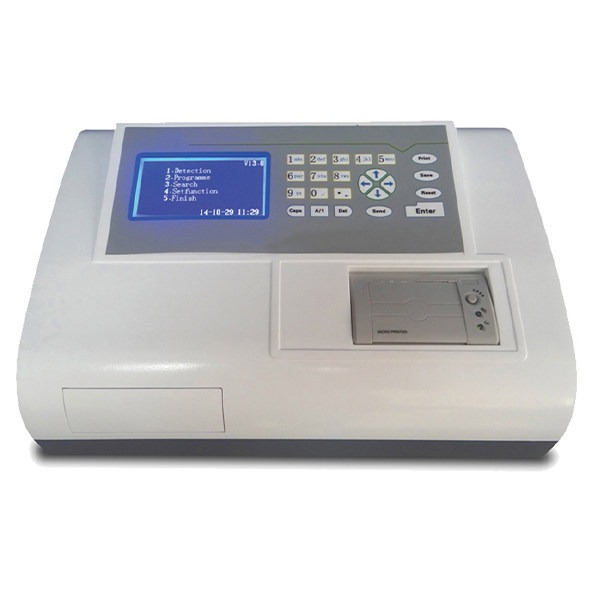
Microplate readers play a crucial role in colorimetric determination, particularly in applications like ELISA. The selection of an appropriate microplate reader involves considering various factors that impact its performance. Here, we explore key considerations in choosing a microplate reader for optimal colorimetric determination.
1. Determination of Wavelength
The determination wavelength of a microplate reader is pivotal for accurate colorimetric assessment. Typically falling between 400 and 750 nm, with an extension up to 800 nm, this range caters to the color determination needs of ELISA. Enzymes like horseradish peroxidase (HRP) and substrates such as tetramethylbenzidine (TMB) contribute to color development. Dual-wavelength colorimetry, involving 450 nm or 492 nm for color development and a less sensitive wavelength like 630 nm, enhances specificity in absorbance readings.
2. Measured Absorbance Range
The absorbance measurement range of a microplate reader is critical, with a general range of 0 to 2.5 covering ELISA requirements. Advancements now allow for ranges exceeding 3.5, ensuring improved precision and linearity in absorbance readings.
3. Detection Speed
The detection speed of a microplate reader directly impacts the precision of colorimetric determination. Faster detection minimizes variations in absorbance among micropores due to different determination times, enhancing overall accuracy.
4. Shake Plate Function
The shake plate function is essential for uniform color distribution in ELISA plate holes before determination. This feature eliminates the need for manual shaking after the color reaction, streamlining the process and ensuring consistency.
5. Incubation Function
Microplate readers offer an incubation function, allowing precise control of internal temperature during ELISA measurements. This feature negates the need for an external thermostat, offering convenience based on laboratory conditions and requirements.
6. Software Function
The software function is a critical aspect, providing statistical analysis and reporting for ELISA qualitative determination. In situations where hardware differences are minimal, software becomes a key indicator of microplate reader quality. Robust software functions greatly assist users in practical work, with features like statistical calculation of positive judgment values, determination of the "cut-off" and "gray area," and curve regression equation calculations enhancing the practical value of the microplate reader.
In conclusion, selecting a microplate reader involves a comprehensive evaluation of factors such as determination wavelength, absorbance range, detection speed, shake plate function, incubation function, and software capabilities. These considerations collectively contribute to the effectiveness and reliability of colorimetric determination in various laboratory applications.
A microplate reader is a vital tool in various fields, including clinical research, biology, agriculture, and food safety monitoring. To ensure the accurate and efficient functioning of this equipment, proper maintenance and usage precautions are essential. This article provides 10 valuable tips for maintaining your microplate reader and outlines precautions to optimize its performance and lifespan.
10 Tips for Maintaining the Microplate Reader:
Stable Environment:
Place the microplate reader in an environment with no magnetic field or interference voltage, lower than 40 decibels, to ensure a stable table without strong vibrations.
Avoid Sunlight Exposure:
Prevent direct sunlight exposure to avoid premature aging of the microplate reader.
Optimal Operating Conditions:
Maintain an ambient temperature between 15°C and 40°C and humidity between 15% and 85% during operation.
Stable Voltage:
Ensure a stable operating voltage to prevent fluctuations during use.
Clean Operating Environment:
Operate in a clean environment, free from water vapor and smoke.
Clean and Level Workspace:
Keep a dry, clean, and level work surface with sufficient operating space.
Regular Cleaning:
Keep the surface and interior of the microplate reader clean. Clean up any spilled samples or reagents promptly.
Avoid Power Interruption:
Do not turn off the power during the detection process.
Timely Shutdown:
Turn off the microplate reader after use and cover it with the dust cover.
Technical Support:
In case of technical failure, contact the microplate reader manufacturer for assistance. Do not disassemble the equipment without authorization.
10 Precautions for Using the Microplate Reader:
No Mixing of Dosing Heads:
If using a dosing device, ensure dosing heads are not mixed.
Thorough Plate Washing:
Wash the microplate thoroughly, preferably with a plate washer, to prevent cross-contamination.
Follow Kit Instructions:
Operate according to kit instructions, ensuring accurate reaction times.
Avoid Contact during Self-Inspection:
During self-inspection, do not touch the loading platform or microplate to prevent accidents.
Prevent Contamination:
Avoid spills on the microplate reader, and wash hands after operations.
Handling Hazardous Materials:
Follow kit instructions for handling polluting, toxic, or biologically hazardous samples to protect operators.
Clean and Disinfect if Contacted:
If the microplate reader contacts polluted or infectious items, clean and disinfect it.
Avoid Power Interruption:
Do not turn off the power during the detection process.
Modify Parameters if Necessary:
Adjust parameters promptly in case of measurement result deviations due to kit issues.
Technical Support:
In case of technical failure, contact the microplate reader manufacturer for assistance. Do not disassemble the equipment without authorization.
Conclusion:
Proper maintenance and adherence to usage precautions are essential for maximizing the performance, accuracy, and longevity of your microplate reader. Following these 10 maintenance tips and precautions will contribute to a reliable and efficient operation, ensuring that your microplate reader continues to be a valuable asset in your laboratory or research facility. If challenges persist, seeking assistance from the manufacturer is recommended for timely and effective resolution.