
An anchor is a vital part of the boat and is one of the most widely used items in the marine industry. The anchor is used to protect your boat. YSmarines which is one of the leading marine anchor suppliers, provides excellent quality products with high performance, beautiful design, maximum protection for boats and various types to meet customer's requirements.
Fluke
Danforth anchors, are the top choice for most marines with overall lengths of 30' or less. Fluke anchors provide sufficient holding power considering their small size. By design, they fold flat and are easy to stow in storage compartments. The anchor arm, or stock, buries itself after the pointed flukes dig into the bottom. For those reasons, fluke anchors are best in hard sand and mud. The flukes can’t penetrate rocky bottoms and are not recommended for slick, grassy bottoms. Loose mud or clay can foul the flukes and prevent bottom penetration.

Navy
The Navy anchor gets the nod for filling in for what the fluke anchor lacks. Navy anchors have long stocks and distinct arks and flukes. They are ideal for heavy grass, weeds and rocky bottoms where one arm can take hold of a crevice.
Claw
Claw anchors have great holding power for their size. Modeled after oil-rig anchors in the turbulent North Sea, the downsized marineing version sets effortlessly and holds in a variety of bottoms. Claw anchors are ideal for the windy conditions for which they are designed. They will hold no matter how much the marine swings around on the hook. Claw anchors are the obvious choice for large, open bodies of water.

Spek
Spek anchor is one type of the stockless anchor. It is the improved anchor with a lower point of gravity from the hall anchor, whose core of anchor head is located in the center of the pin centerline to the bottom. The structure of spek anchor is characterized that there is anchor crown plate and reinforcing ribs at the anchor crown. The anchor claw is easy to turn to the ground and then has a better stability. The smart design makes it a perfect fit for the anchor pocket. And the anchor flukes will keep naturally upwards and overturn immediately when touching the hull plate to avoid damaging the shell plating.

TW Type
The TW type pool HHP anchor has more than 2 times holding power than the conventional anchor of the same weight. The anchor has large flat flukes made out of high tensile steel plate material. The thickness varies from 15 mm up to 140 mm depending on the anchor size. It allows a weight reduction of 25% compared to a conventional anchor for the same equipment number It has a fully balanced type and unbalanced type. The fully balanced type always has its flukes in a vertical position while lifting the anchor. The unbalanced type will tip over to one side.

Mushroom
Ideal for canoes, kayaks and jon marines, the mushroom anchor works best in soft bottoms, where it creates penetration based on suction. Makes a decent lunch hook anchor, but is not recommended as the primary anchor.

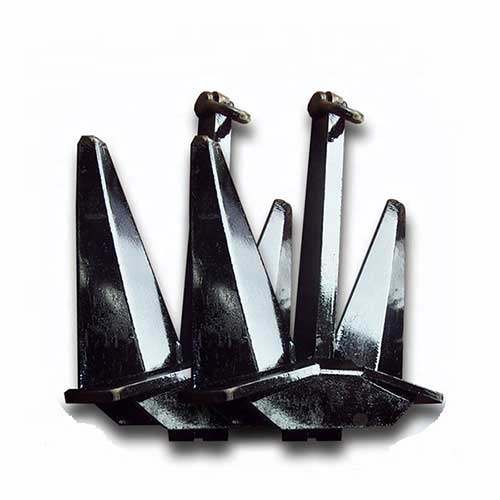
Does your marine have an anchor? If so, is it of sufficient size and strength to hold your marine in place? Believe it or not, many marine owners decide on which anchor to buy based on convenience and storage space. Before you select a marine anchor, read these tips to get started making the best choice.
Weight
Bigger is better when choosing anchor weight. You won’t need as much for holding the marine in a quiet cove, but you will need much more weight for an emergency situation in the wind. You can also carry two anchors of differing weights. A smaller “lunch hook” is adequate for short anchorages in calm water when you will be keeping watch on the anchor. You’ll also want to have a larger “working anchor” for overnight trips or when going ashore in gusty winds. Using two differing anchor styles can also be beneficial, especially with high-profile marines like pontoons.
Bottom conditions
Holding power and weight is only as good as the anchor’s ability to penetrate the bottom. Anchors easily penetrate hard sand bottoms, which offer consistent holding power. You get less in mud, which the anchor must penetrate to reach a harder secondary bottom material. Anchor weight is more important than design in difficult grassy bottoms.
Holding power
It might make sense to choose an anchor based on the weight of the marine. However, anchors are rated by their holding power, or the amount of pull force the anchor must withstand to hold the marine in place. Holding power is formulated based on environmental factors, like wind speed. As a general rule, holding power of 90 pounds is sufficient for safely anchoring a 20' marine in winds up to 20 mph. For the same wind speed, a holding power of 125 pounds is adequate for a 25' marine. This is why high holding power anchors that rely strictly on their weight—such as a space-saving, plastic-coated 10-pound mushroom anchor—are only capable of generating more than twice their weight in holding power. A 20' fiberglass bass marine using a 20-pound anchor will always drag if the design is the only buying consideration.
Marine anchors can act as drogues (positive drag mechanism) for ships and other such vessels during storms. They provide a restoring drag that keeps the vessel stable and steady and prevents slamming of the bow or flooding through green water loading during unsteady conditions.
Danforth Anchor
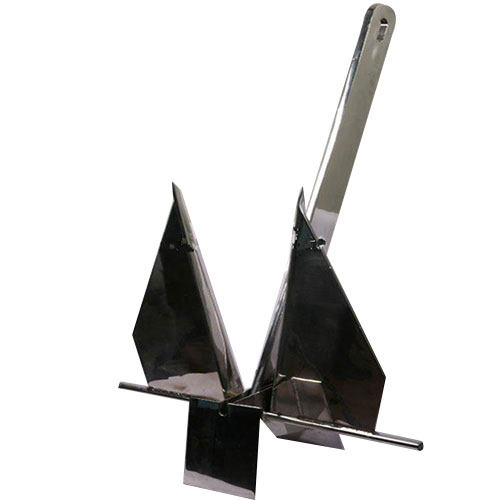
The Danforth is a lightweight, cheap and easily storable design that uses two triangular blades or flukes attached to the shank to hook or dig into the ocean bed. The gap between the flukes allows for the Danforth anchor to grip onto debris and rocks instead of simply acting as a sail against the water currents. Also, the shank and flukes are hinged, so that the orientation of the flukes can be changed depending on the type of material on the seafloor.
Stockless Anchor
Stockless anchor is a normal type of stockless anchor with a small ball on a fluke. With the stockless design, it fits the anchor pocket perfectly. It is commonly used in commercial vessels and recreational craft. It is made high quality cast carbon steel and is a great mooring device for fishing boats due to the large holding power and easy storage.
Spek Anchor
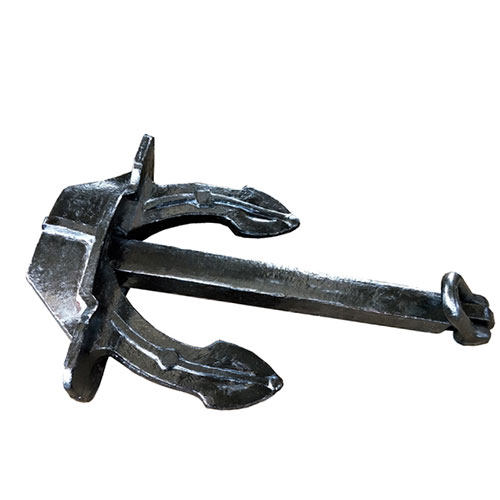
Spek anchor is one type of the stockless anchor. It is the improved anchor with a lower point of gravity from the hall anchor, whose core of anchor head is located in the center of the pin centerline to the bottom. The structure of spek anchor is characterized that there is anchor crown plate and reinforcing ribs at the anchor crown. The anchor claw is easy to turn to the ground and then has a better stability. The smart design makes it a perfect fit for the anchor pocket.
Bruce Claw Anchor
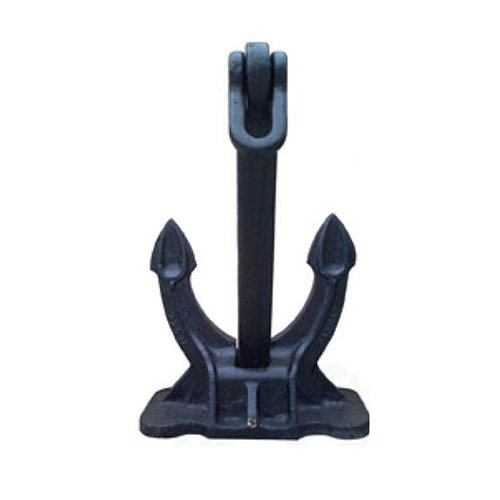
This type of bruce claw anchor is commonly referred to as the claw because of its shape and design. It is used to hook into the rocks at the bottom of the ocean and then settle in. However, it does not work when the material at the bottom is loose sand, silt or mud. Also, weeds and other structures can entangle the claw of the anchor without providing any actual anchoring force. Instead, they tend to impede the recovery of the anchor when it is time for the vessel to move on.
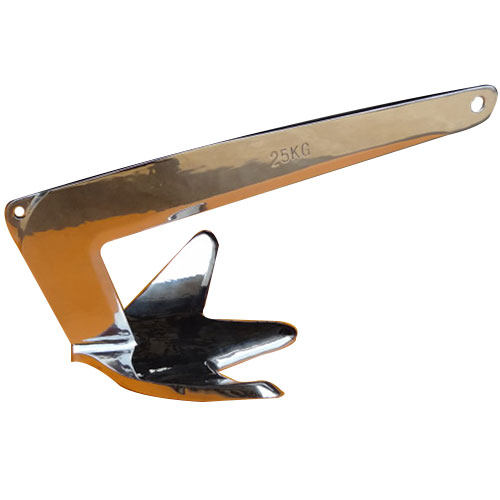
Other types of equipment that are used in conjunction with an anchor to hold down a vessel or installation floating on the surface of the water include riggings (such as trip lines), anchor chains and ropes, stowage equipment, etc. Anchor chains and ropes are an important factor in determining the reliability of a given anchor since these provide the only connection between the structure and anchor. They must be able to withstand tremendous amounts of force both in tension and contraction. Similarly, trip lines must also be strong enough to apply force on the anchor to orient it in a particular direction.
An anchor refers to nautical or marine equipment intended to restrict vehicle or structural movement in the water. Anchors achieve their purpose by either using their weight to hold structures in place, clamping on to the bed of the waterbody, or using a combination of both these techniques.
Mushroom anchors
Mushroom anchors, as the name suggests, are shaped like inverted mushrooms, with the head being laid in the sea or ocean bed. This style of anchor utilizes its weight, suction power and relative friction between the bed and anchor head to keep itself firmly attached to the strata of the ocean floor. However, it only works in conditions when mud, silt, or sand are prevalent on the floor of the ocean.
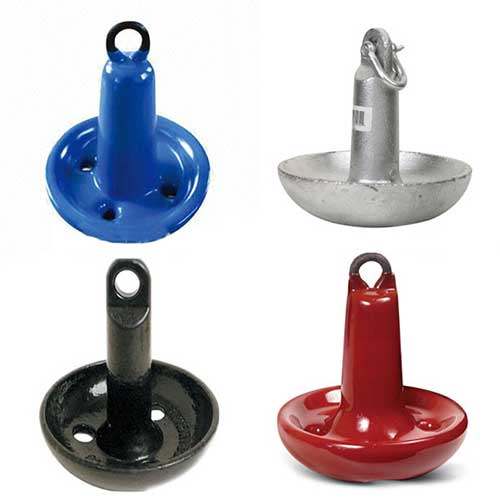
Other materials such as rock and sand are not able to provide the adhesion required to keep the anchor firmly attached to the ocean floor. The science behind how this system works is that the anchor uses a derived version of the Archimedes Principle on soft, granular or viscous media such as mud and sand.
While the strength provided by these anchors makes them very useful in restricting motion, they can only work in regions where the floor of the ocean or sea provides sufficient suction to drag down the anchor. This makes them ideal in regions close to beaches or lagoons.
High holding power anchor
High holding types are a class of anchors that are characterized by their High Holding Power (HHP) or Super High Holding Power (SHHP). These High Holding Power (HHP) anchors are used in the oil and gas industry to tether large semi-submersible structures or to hold down underwater pipelines running across the ocean bed or seafloor. Such anchors are considerably larger and heavier than their counterparts.
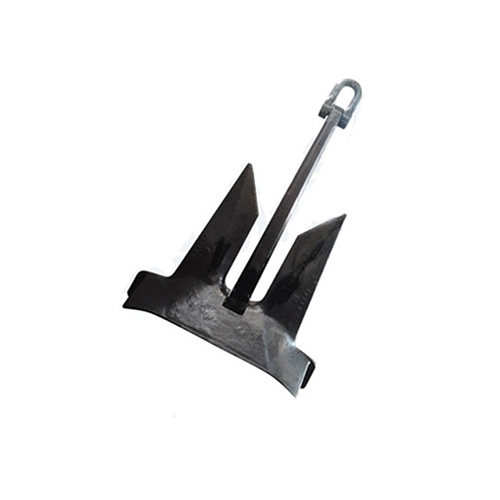
To be declared as a high holding anchor, they must exhibit strength and retention capabilities equal to twice the normal values of conventional anchors. The conventional anchor considered for reference purposes must be the same weight as the HHP anchor being tested. To achieve this tag, three tests must be conducted successfully, and the anchor must be tried in a minimum of three different types of soil. Compared to the previous two types of permanent anchors, this classification ensures that the anchor functions in any type of condition.
All products provided by YSmarines which is one of the leading marine anchor manufacturers in China, have been approved by ABS, LR, DNV, GL, BV, RINA, BKI, CCS, etc, high standard materials and the most competitive price guaranteed.
The anchor is widely used for dredging, offshore mooring, fish farm, and yachting operation, with SS316L material option or with H.D.G. finishing for your multi-purposes. You sometimes need to set two anchors in a crowded anchorage, with anchors at the bow and stern of the marine to limit its ability to swing. Two anchors set from the bow at a 60° angle are another good way to improve security against swinging and dragging, and they allow you to shorten the rodes and use less scope. In heavy weather conditions, where one anchor may not have enough holding power, setting a second anchor may be critical to staying put. Remember that as the wind speed doubles the force on the marine (and the ground tackle system) increases by four times.
Choose an anchor that’s the right size for your marine and the locations and weather where you anchor. Take the anchor manufacturer’s suggested sizes into account and consider your marineing style. Do you typically anchor for two hours or for two weeks, in a lake or in the Atlantic Ocean? The recommended anchor sizes from YSmarines will work well for most marineers, under most conditions.
Sizing an anchor for your marine reinforces, with some limits, the “bigger is better” idea. If your engine fails and you are drifting toward a lee shore, having a properly sized anchor ready could save your marine. But raising the anchor by hand, with no electric powered windlass, calls for light and efficient ground tackle (and a strong back).

You have three options: galvanized steel, Grade 316 stainless steel or lightweight aluminum/magnesium. Most marineers choose a galvanized anchor for cost reasons, with the added advantage of having the highest tensile strength. Stainless anchors resemble works of sculpture to dress up the bow of your vessel.
YSmarines is a professional marine anchor supplier and carries superior quality products with fast delivery anywhere in the world, various types including stockless anchor, folding anchor, spek anchor, bruce claw anchor, etc, with professional certification like DNV-GL, BV, ABS, LRS, RINA, IRS, etc.
