
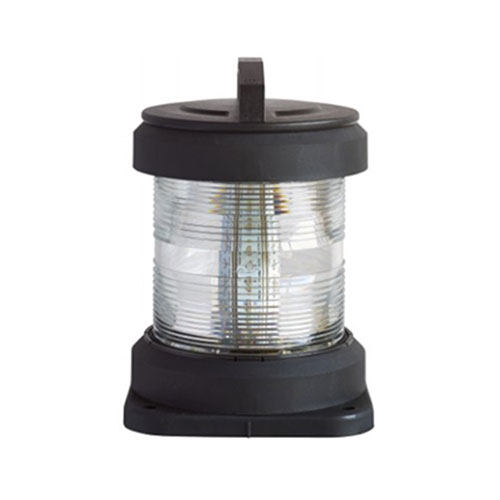
The specific installation position, lighting angle and the brightness for the navigation light, all have special requirements. The irregular use or failure of the navigation light will transmit the error signal and caused huge obstacles for the collision prevention.
Masthead light
It is installed above on the mast of a ship or above on the centerline, showing uninterrupted in the 225 degree horizontal arc.
Sidelight
It is installed on the left and right sides of the highest boat deck. The screen of sidelight facing the light surface should be coated with the berlin black. The height of the screen is at least equal to the height of the lamp. The boat which has a length of more than 80 meters, should install red, green sidelight on the bow, stern.
Stern light
The boat stern light should be installed in the middle of the stern. The height of the light should be kept horizontally with the sidelight as possible, but can’t be higher than the height of the sidelight.
Headlight
The marine headlight is placed in the bow of the pusher barge and the height can’t be higher than the headlight.
Red-green flashing light
It is the left red, right green marine flash lighting installed above the sidelight and its flashing frequency is 50 to 70 per minute. The boats with a length of less than 12 meters can also adopt a water torch instead of red and green flashing lights and should keep light bright with clear color.
Anchor light
The marine anchor light is installed on the top of the mast with all-around flashing.
Each provision concerning the navigation light must be observed from sunset to sunrise. The signal lights can also be displayed in the situation that the visibility is poor during the day. At the time of navigation light displaying, the lighting which confuses or weakens the display performance of the signal light, can’t be allowed to display.
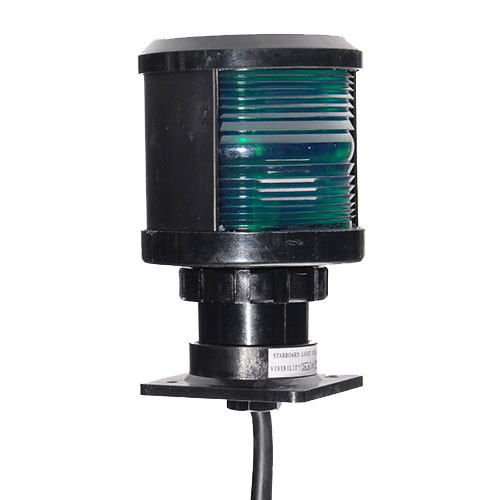
The Function Requirements
1. The navigation light should be waterproof and the lamp holder should have a structure that prevents its own loose. It should adopt a two-filament bulb. The control box should be in the cab and the switch of the control box should have an instruction to explain its use. The cable of the navigation light is fastened with the complete lampshade & bulb and the good & reliable ground.
2. The switch should be set on the navigation light control box, used to convert the power supply. Each navigation light should be powered by a separate branch that is placed close to the control box installed in the cab and should adopt the switch and fuse which are installed in the control box for control and protection of each insulation of these branches.
3.The navigation light control box should be powered directly from the main distribution board and emergency distribution board.
4. There should be an automatic indicator that can make an auditory or a visual alarm signal at each navigation light and there should be some measurements which are adopted to prevent the navigation light go out due to the signal light failure. The auditory and visual alarms for the failure of the navigation light control box should be provided.
The article has combed the key requirements and regulations for navigation lights and signal lights, giving an explanation for the various types and functions of the boat navigation light.
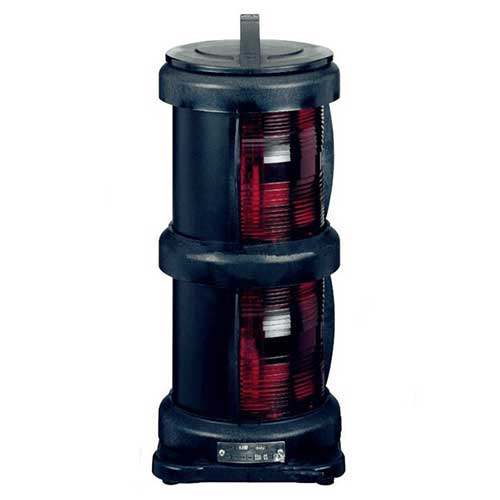
The marine navigation light, also known as a marine signal light, is used to show the state of ship sailing or parking, which can indicate the navigation direction at night and the size of the ships. It is an important basis for ships to adopt avoidance measures and effectively avoid collisions among ships, especially at night or in poor visibility.
The Categories Of Marine Navigation Light
The ship navigation signal system is an important part of the ship's security and it’s an important lighting system to ensure the safety of night boating. According to the international regulations for preventing collisions at sea, the navigation signal equipment must be installed on the ship with ship navigation lights, ship signal lights and foghorn. The navigation lighting system includes headlight, sidelight, stern light, towing light, anchor light, yellow all-round flashing light, maneuvering signal light and flashing light.
Headlight
The ship headlight is white light placed above the centerline of a ship, showing uninterrupted in the 180 degree horizontal arc.
Sidelight
The sidelight generally refers to the green light on the starboard and the red light on the portside. Each light is showing uninterrupted in a 112. 5 degree horizontal arc.
Stern light
The marine stern light is the white light which is installed on the place as close to the stern as possible.
Towing light
The boat towing light refers to the yellow light placed as close as possible to the stern, showing uninterrupted in the 135 degree horizontal arc.
Anchor light
The anchor light is a type of boat signal light, which is displaying uninterrupted in a 360 degree horizontal arc.
Flashing light
A marine flashing light is a signal light that is flashing with the frequency of 120 or above 120 per minute.
Navigation light indicator
It is an indicator centralized control of the on-off of the navigation lights and a device that can give an alarm when the navigation lights fail.
For more detailed introduction, please visit the article page of Basic explanation for marine navigation light.
The anchor has a large holding power to weight ratio, so it is called a high holding power anchor. The gripping force is more than two times larger than the ordinary stockless anchor of the same weight. There are Martrosov anchor, Danforth Anchor, Schdringer anchor, Staccato anchor, etc.
A high holding power anchor is classified into a stocked anchor and a stockless anchor. Its general feature is that the anchor fluke is wide and long with deep gnawing soil, good stability.
1.Stocked high holding power anchor
The typical kinds of this anchor are the Danforth anchor and Steven anchor.
The anchor head is provided with a stabilizer bar to ensure stability, generally suitable for more soft substrates, with inconvenient storage, so this type of HHP anchor is suitable for engineering ships and small ships.
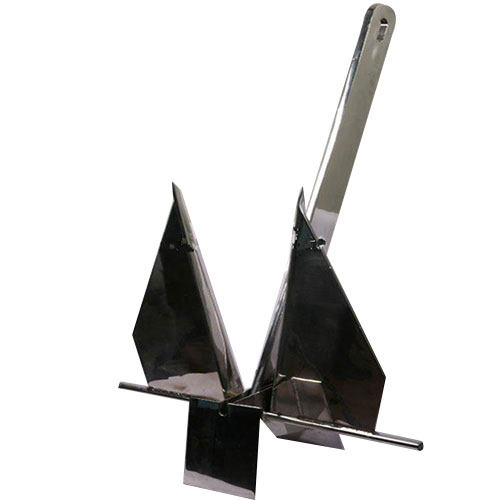
Danforth anchor
The Danforth anchor is also known as swallow anchor and the anchor fluke is rotated about 30 ° back and forth. The holding power to weight ratio is generally greater than 10, mostly used in engineering vessels.
Steven anchor
The anchor has a short and large fluke, and the maximum angle of the anchor fluke can be adjusted by the movable wedge mounted on the anchor rod to accommodate a variety of substrates. The holding power to weight ratio is 17 to 34, widely used as a positioning anchor for oil platforms.
2.Stockless high holding power anchor
The stockless HHP anchor is developed by the stock HHP anchor. It has improved the anchor fluke of the stockless anchor. The typical stockless high holding power anchor is the AC-14 anchor developed by the United Kingdom and the Boer anchor developed by the Netherlands.
AC-14 anchor
The AC-14 anchor is a commonly used anchor. The anchor fluke can have an allowable deviation for the left and right corner within 1 degree. AC-14 anchor is a casting anchor with black painting surface treatment. It has the advantages of stable structure, thick and wide flukes, adaptability to various substrates, rapid gnawing, high gripping stability with holding power to weight ratio ranges from 12 to 14. So it is commonly used as the bow anchor in the large ship or ro-ro ship.

Boer anchor
The Boer anchor also called TW type anchor or N type anchor. It has smooth and sharp anchor flukes, with the advantages of adapting to a variety of substrates, high stability, convenience for dropping and weighing anchor, easy for storage, suitable for the bow anchor in a large ship and positioning anchor in a workship.

The high holding power anchors, which include Danforth anchor, AC-14 anchor, TW type anchor, etc, have the advantages of great gripping force, deep gnawing, high stability, commonly used in a wide variety of ships.
The boat is difficult for berthing when encountering the strong wind. It completely relies on boat anchor. The marine anchor is the main component of the anchoring and mooring system. One end is fixed on the boat with a marine anchor chain and the other end is a barbed claw shape, throwing to the bottom of water or shore to highly stabilize the boat.
Work Principle Of Marine Anchor
Marine anchor is composited of anchor buckle, anchor bolt, anchor stock, anchor handle, anchor wrist and the symmetrical part on both sides is called anchor fluke which is the most important part of the anchor to grab into the dirt. After the ship is anchored, the anchor is sinking to the bottom of water under the traction of the anchor chain. The plane where the anchor wrist is located is perpendicular to the water bottom with the anchor rod. At this time, the anchor fluke will be in contact with the bottom of the water.
The length of the ship anchor chain is often longer than the depth of the water, so the anchor chain in the water bottom has a lying- flat state. When the ship is disturbed, the anchor chain will be pulled. The anchor in the bottom of the water under the action of the horizontal force. The role of the anchor itself acts on the contact point of the anchor fluke and the water bottom. The two-force synthesis makes an anchor move downward, which is anchoring the process. After that the anchor is pulled into the bottom of the water, which can provide the ability for boat berthing.
The Categories Of Marine Anchor
The factors that should be considered for choosing the marine anchor include easy operation, convenience to store and economic application. The most important factor is the anchor grip. The anchor grip is different because of the anchor type and the submarine soil.
There are many kinds of marine anchors. According to the different structures and uses, the ship anchor can be classified into a stocked anchor, stockless anchor, high holding power anchor and special anchor. The bow anchor adopted by the merchant ship is a stockless anchor, while the stern anchor sometimes adopts a stocked anchor or a Danforth anchor.
1. Stocked anchor
The anchor has the advantages of a simple structure, large holding power to weight ratio and high grip stability, but it has inconvenient anchoring operation and storage with an anchor stock. Therefore, this anchor should not be used as a bow anchor for commercial ships, suitable as a stern anchor, generally used for small boats.
2. Stockless anchor
It is also known as the hall’s anchor and the generally adopted stockless anchors for merchant ship are Hall anchor and Spek anchor. The anchor fluke and anchor rod can rotate at a certain angle and is a stockless type. The holding power to weight ratio is 2.5 to 4 and the maximum is up to 8. The anchor has a simple structure, throwing anchor operation and storage conveniently, so it is suitable for the bow anchor with the widest applications. But it also has the disadvantage of a small anchor grip. The Hall anchor is the earliest used type and the Spek anchor is an improved type of Hall anchor, which has the advantage that its anchor fluke can be naturally upward.

3.High holding power anchor
It is combined with the advantages of a stocked anchor and a stockless anchor. Because of the large gnawing soil of the anchor fluke and the large gripping force, it is suitable for the sandy or soft water bottom. The commonly used HHP anchors are the Martrosov anchor and Danforth anchor which is characterized by the deep gnawing soil, high stability, with large anchor grip. But the strength of the anchor fluke is weak and easy to deform.

4.Special anchor
It has different shapes, compared to the general anchors, such as single claw anchor, screw anchor and mushroom anchor. It often has special applications, used in a permanent mooring such as a floating tube, a buoy, a lightboat, the floating dock and a floating wharf.
For more professional knowledge, please visit the article page of What is a marine anchor
When the inflatable life raft is used, the raft and the storage cartridge can be thrown directly into the water. The life raft can be automatically inflated. When the ship sank too fast under the water, it is too late to throw it into the water surface. The hydrostatic pressure release on the raft will automatically remove and the emergency inflatable life raft will be released, floated automatically.

The detailed steps as follows
1.Take the hook opening on the hydrostatic pressure release and launch the small ring, making the chain hook fall, or rotating the manual release device, and the raft will slide to the sea.

2.When the height is less than 11m from the water surface, or when the raft is thrown into the water, it is necessary to continue to pull out the first cable and open the valve of the inflatable cylinder, so that the raft is floated above the seawater.

3.If there is an overturned state, it should be centered. The person should wear a life jacket, and climb the bottom of the raft. When standing in the steel bottle, the hands pull the bottom, squatting and hypokinesis.

The Installation Of Inflatable Life Raft
When the inflatable life raft is folded, it is stored in the glass steel storage cartridge. Generally, it is generally arranged on the two-port boards. When installing, the raft is welded to the ship deck, ensuring that the storage cartridge is in the hierarchical position, and the fix is with the kundy which is connected to the raft and the manual detachment assembly. The assembly components are connected to the hydrostatic pressure release.
1. The bowline that is taken from the life-saving raft cylinder, is firmly connected to the hydrostatic pressure release ring, and there is an easy-to-break rope on the connecting ring, and the other end of the easy-to-break rope should be connected in the hydrostatic pressure release.
2. It is not allowed to pull the bowline from the storage cartridge.
What Should Be Paid Attention To The Use Of Inflatable Life Raft
1. When the life raft is drifting too urgently, the sea anchor can be put into water and reduce the rafting speed.
2. in order to avoid the wind and waves, the enter-exit door should be put down, and the duty for looking out will be strengthened through the hoping window on the raft hanger.
3. If there is water in the raft, take out the water scoop from the repair bag and drain it with the absorbent sponge.
4.In the night, using the flashlight to emit a Mousta signal, during the day, the mirror is transmitted by the sunlight.
5. When it is raining, utilize the drinking water bottle and the water pipe and deposit the rainwater to prepare for drinking.