
Currently, freeze-drying technology is extensively utilized in various fields such as medicine, biological products, food, active substances, and nanomaterials. Laboratory freeze dryers play a vital role in research and development, testing applications in academic institutions, corporate laboratories, experimental scientific research in industries like bio-cosmetics and pharmaceuticals, as well as experimental research and development in the food and medicinal materials industries, nanomaterials, chemical materials, and other industrial scientific research applications.
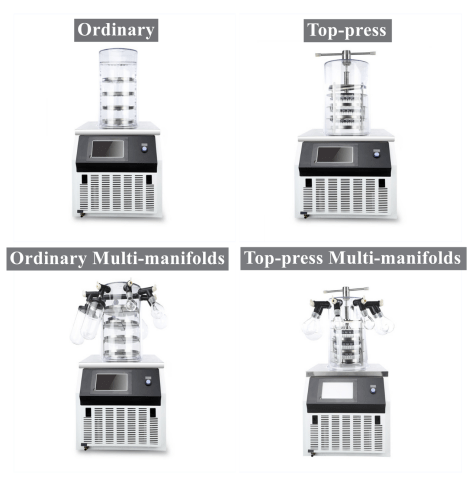
In laboratory settings, the equipment often required is known as a Laboratory Freeze Dryer. Its primary function is to aid in the restoration of the conformation and biological function of bioactive substances before freeze-drying after redissolving. So, what exactly is a freeze dryer and what are its characteristics?
A Laboratory Freeze Dryer operates on the principle of freeze drying, also referred to as drying, sublimation drying, or freeze-drying for short. It is a drying method employed for the purpose of preserving items.
The degradation, spoilage, and deterioration of items are primarily caused by two factors: external and internal factors. External factors encompass the effects of air, water, temperature, and biological elements. By minimizing the impact of external and internal factors, it becomes possible to achieve the objective of preserving items unaltered for a certain period.
The drying process involves the removal of moisture contained within the item, as moisture is a necessary condition for the growth of all living organisms. When the water content of an organism is sufficiently reduced, its ability to grow and reproduce becomes hindered or even impossible. This enables the item to be stored for extended periods. Additionally, the presence of water can lead to the dissolution of certain acids and alkalis, resulting in chemical reactions that cause the deterioration of goods.
Key features of laboratory freeze dryers include:
Ordinary Type: Used for a wide range of materials, these freeze dryers allow the materials to be directly placed into the material tray for freeze-drying.
Gland Type: This type is suitable when the material needs to be dried within a vial, and it should not be exposed to the outside air after drying. The vial is sealed under a vacuum after the drying process is complete.
Multi-Manifold Type: When drying multiple varieties of materials simultaneously without them affecting or intersecting each other, the multi-manifold type is required. It facilitates observation and temporary sampling.
Multi-Manifold Gland Type: This type is chosen when there are various materials that need to be dried, and some require processing in vials, while others require different methods.
Small In-Situ Pre-Freeze Type: This type enables in-situ pre-freeze drying, with features such as one-button start, adjustable temperature, controllable production process, program operation prompt function, and automatic control of the entire freeze-drying process. It offers the option to select program mode or vacuum mode.
Before utilizing a freeze dryer, several preparations should be made:
Verify the normal power supply voltage for the freeze dryer.
Ensure the accurate placement of the temperature measurement camera within the freeze-drying chamber.
Check the mechanical pump's vacuum pump oil in the freeze dryer. It should be clear and not too thick, and the oil quantity should correspond with the oil mirror.
Inspect the gate valve components in the ultrafiltration device to ensure they meet the normal working standards. Close all gate valves leading to the air.
Ensure the defrosting water in the cold trap has been drained completely.
Maintenance of a laboratory freeze dryer is crucial and must adhere to specific requirements, particularly regarding the inspection and replacement of lubricating grease. The replacement cycle of lubricating oil in a laboratory freeze dryer is influenced by the temperature at the compression end. When the temperature at the compression end is high, the lubricating oil should be replaced more frequently.
Generally, lubricating oil should be checked every 10,000 hours of continuous operation. When the compressor is initially operated, it is recommended to change the lubricating oil and clean the oil filter after 2,000 hours of operation. If the system is operating properly, the lubricating oil should be changed every 20,000 hours. When inspecting and replacing the lubricating oil, it is important to avoid prolonged exposure to air due to the freezer's water absorption.
In the event of a laboratory freeze dryer failure, a thorough investigation of the cause is necessary. If needed, it is advisable to seek assistance from a professional company to identify and rectify the issue.
If the motor of the laboratory freeze dryer burns out, impurities such as patent skin can spread throughout the refrigeration system. During maintenance, the entire system's filtration system should be thoroughly inspected and replaced if necessary. Improper handling in this regard can have detrimental effects on the compressor's long-term operation, and even lead to irreversible consequences due to minor losses.
After overhauling the compressor, the system should be dehumidified. It is recommended to pass dry nitrogen through the system for drying, followed by vacuum treatment. The lower the vacuum level, the more advantageous it is for subsequent system operation, as it increases efficiency. Testing for leaks and maintaining pressure should be taken seriously, as most refrigeration system failures stem from leaks in the system.
A freeze dryer is a scientific method that pre-freezes water-containing goods before sublimating their moisture in a vacuum state to produce dry items. The freeze-dried items can be preserved for an extended period of time and can be restored to their pre-freeze-drying state while retaining the original biochemical properties after adding water.
Vacuum freeze-drying technique has numerous applications in bioengineering, pharmaceutical industry, food industry, material science, and deep processing of agricultural and byproduct products, and the scale and field are continually developing. To that purpose, vacuum freeze-drying will be a significant application technology in the twenty-first century.
The structure of the Lab freeze dryer
A refrigeration system, a vacuum system, a heating system, and an electrical instrument control system comprise the freeze dryer. The drying box, condenser, refrigeration unit, vacuum pump, heating/cooling device, and so on are the essential components.
The refrigeration system, also known as the "heart of the freeze dryer," is the most critical component of the freeze dryer. Compressor, refrigerant, oil separator, water condenser, filter drier, intercooler, sight glass, solenoid valve, hand valve (top cover valve), expansion valve, evaporation (plate exchanger, rear box condensing coil), vapor-liquid separator, return air filter, pressure gauge, pressure control relay, CPCE (energy regulator), safety valve, refrigeration pipeline, and other components comprise its refrigeration system.
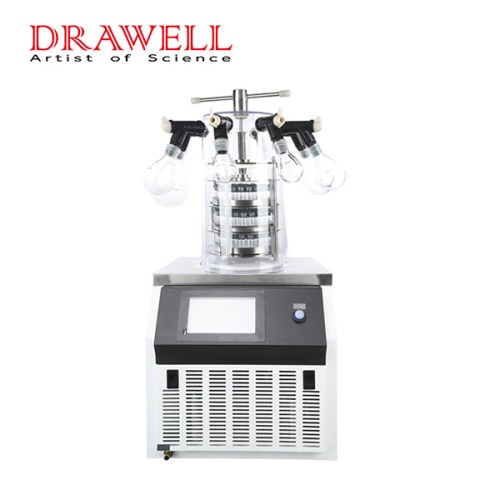
How does Freeze Dryer work?
Freeze drying is a drying process that works on the sublimation concept. It is a method that involves rapidly freezing dry material at a low temperature and then directly sublimating the frozen water molecules into water vapor in a suitable vacuum environment. Freezing The dried product is known as a lyophilizer, and the process is known as lyophilization.
After the liquid refrigerant absorbs the heat of the cooled material in the evaporator, it is vaporized into low-pressure and low-temperature steam, which is inhaled by the compressor, compressed into high-temperature and high-pressure steam, and then discharged into the condenser. It releases heat to the cooling medium (water or air), condenses into a high-pressure liquid, is throttled by a throttling device to a low-pressure and low-temperature liquid, and enters the evaporator again to absorb heat and vaporize.
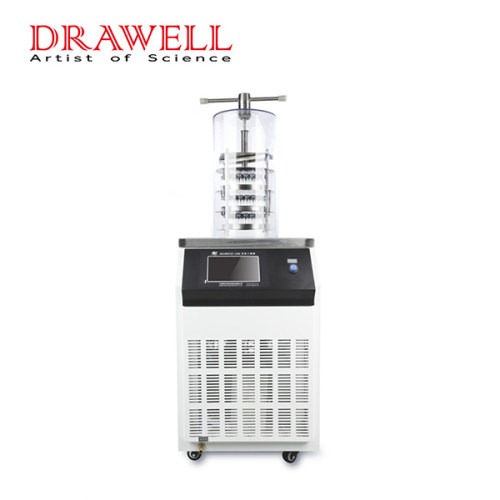
How do I select a freeze dryer?
Many precise features must be considered while selecting a freeze drier. Customers must purchase a freeze dryer that meets their requirements. When selecting a freeze dryer, examine not only the price, but also the temperature of the cold trap, the cooling rate, the temperature homogeneity of the board, the flatness, and other indicators.
Cold Trap Temperature
A cold trap is a device that traps water during the freeze-drying process. In theory, the lower the temperature of the cold trap, the greater its ability to catch water. The experimental series freeze dryer's cold trap temperature has multiple classes, including -45°C, -60°C, and -80°C. Some items that are easily freeze-dried can benefit from freeze-drying with a cold trap temperature of -45°C. Most items can be freeze-dried using freeze-drying devices with a cold trap temperature of around -60°C. Freeze-drying with a -80°C cold trap temperature It is appropriate for the lyophilization of some specialty items. The influence of cold trap temperature on water-capturing ability was experimentally established, with the water-capturing capacity greatly increased when the temperature of the cold trap dropped from -35°C to -55°C. In the absence of unique requirements, a cold trap temperature of roughly -60 °C is an excellent choice.
Cooling Rate
The cooling rate reflects the refrigeration system's cooling capacity. The temperature of the cold trap shall reach the minimum temperature indicated in the index within 1 hour under no-load conditions. For a freeze dryer with a cold trap temperature of -60 °C, for example, the machine begins timing from the time the machine is turned on for refrigeration, and the time for the cold trap temperature to reach -60 °C should not exceed 1 hour.
Ultimate Vacuum
The final vacuum degree shows the leaking of the freeze drier as well as the vacuum pump's pumping performance. The freeze-drying box's vacuum level. Previously, the higher the vacuum degree, the better. According to contemporary thinking, the vacuum degree should be within a tolerable range. The vacuum degree is too high, which inhibits heat transfer and slows drying, yet the no-load limit vacuum degree of the freeze-drying box should be greater than 15Pa.
Uniformity of plate temperature and flatness
The consistency and flatness of plate temperature have a significant impact on product quality uniformity. The higher the temperature uniformity and flatness, the higher the quality of the freeze-dried product. The temperature of the freeze dryer shelf can be controlled by a heater or an intermediate fluid. The temperature uniformity and flatness of the freeze dryer shelf with an intermediate fluid control layer are excellent. This layer of freeze dryer plate is a hollow sandwich structure. The cooling and heating of the plate are accomplished through the circulation of the intermediate fluid in the fluid channel within the plate, resulting in consistent plate temperature. The fluid in the centre of the shelf technology is used by the freeze dryer. The bell-type freeze dryer's shelf temperature control employs a heater, resulting in slightly poorer temperature uniformity of the plating layer. However, the temperature difference between the layers of the medical freeze dryer should be kept within 1.5 °C, and the temperature difference inside the plate should be kept within 1 °C, and the food freeze dryer can be suitably relaxed.
Summary
We can deduce from the preceding information that different types of laboratory freeze dryers should be used depending on the industry. For many years, DRAWELL has been the most successful freeze dryer producer in China, offering high-quality freeze dryers to laboratories all over the world. Please contact us if your laboratory requires a freeze dryer or other laboratory equipment; we will be your best choice.