
Homogenization is a critical process used in various industries—such as pharmaceuticals, food and beverage, cosmetics, and biotechnology—to reduce particle size, improve product stability, and ensure uniform dispersion of components. Two widely adopted technologies for achieving efficient homogenization are ultrasonic homogenizers and high-pressure homogenizers. While both serve similar purposes, they operate on different principles and offer distinct advantages depending on the application.

What Is an Ultrasonic Homogenizer?
Ultrasonic homogenizers use high-frequency sound waves to create cavitation in liquids. Cavitation refers to the formation, growth, and implosive collapse of microscopic bubbles, which generate intense shear forces and micro-jets. These forces break down particles, disrupt cells, and promote thorough mixing at the microscopic level.

Key Features:
Operates at ultrasonic frequencies (typically 20–40 kHz).
Ideal for small to medium-volume processing.
Effective for cell disruption, nanoparticle dispersion, and emulsification.
Offers precise control over energy input.
What Is a High-Pressure Homogenizer?
A high-pressure homogenizer forces a liquid or suspension through a narrow valve at very high pressure, often ranging from 100 to 2000 bar (or even higher). As the liquid passes through the homogenizing valve, it experiences extreme turbulence, cavitation, and shear forces, resulting in reduced particle sizes and uniform mixtures.

Key Features:
Operates at high pressures (100–2000+ bar).
Designed for continuous, large-scale processing.
Excellent for emulsifying immiscible liquids and breaking down complex structures.
Delivers consistent results for high-throughput applications.
Main Differences Between Ultrasonic and High-Pressure Homogenizers
1. Working Principle
Ultrasonic homogenizers use acoustic cavitation to break particles apart, while high-pressure homogenizers rely on mechanical shear and impact forces created by forcing liquid through a small orifice at high pressure.
2. Equipment Design
Ultrasonic systems are typically compact and consist of a generator and probe (horn). High-pressure homogenizers are more complex and include a high-pressure pump and homogenizing valve assembly.
3. Volume and Throughput
Ultrasonic homogenizers are better suited for small to medium batches, such as lab-scale or pilot-scale applications. High-pressure homogenizers are built for large-scale continuous processing, making them ideal for industrial production.4. Application Focus
Ultrasonic systems excel at cell disruption, nanoparticle dispersion, and deagglomeration. High-pressure homogenizers are preferred for emulsions, suspensions, and viscous formulations, especially when consistent results are critical at scale.
5. Particle Size Reduction
Both methods achieve fine particle sizes, but high-pressure homogenizers often deliver narrower particle size distributions, which is crucial for high-end emulsions and drug delivery systems.
6. Cost and Maintenance
Ultrasonic homogenizers are generally lower in cost and easier to maintain. High-pressure systems are more expensive and require more maintenance due to their high-stress operating conditions.
Applications Comparison
In the pharmaceutical industry, ultrasonic homogenizers are commonly used for applications such as cell lysis, DNA shearing, and dispersing nanoparticles in research and small-batch formulations. They are particularly effective for disrupting biological cells and creating fine dispersions for laboratory studies. High-pressure homogenizers, on the other hand, are preferred for larger-scale pharmaceutical manufacturing, including the preparation of stable drug emulsions, vaccine formulations, and nanosuspensions that demand precise and consistent particle size reduction.
In the food and beverage sector, ultrasonic homogenizers are suitable for tasks like flavor extraction, dispersing ingredients in small batches, and emulsifying specialty products on a limited scale. In contrast, high-pressure homogenizers are the standard equipment for large-scale production processes such as milk homogenization, fruit juice stabilization, and the creation of smooth, stable sauces and dressings, where continuous operation and product consistency are critical.
In cosmetic manufacturing, ultrasonic homogenizers are typically used in research and development for formulating and testing emulsions, serums, and lotions on a small scale. They are useful for trial batches and adjusting ingredient interactions. However, for commercial-scale production of creams, emulsions, and other viscous cosmetic products, high-pressure homogenizers are more suitable due to their ability to produce uniform, stable textures in large volumes.
In biotechnology applications, ultrasonic homogenizers are favored for disrupting microbial or mammalian cells to release intracellular components, as well as for fragmenting genetic material in laboratory protocols. High-pressure homogenizers are more commonly used in large-scale fermentation processes where the breakdown of biomass or cell walls needs to be consistent and efficient across high volumes.
In the field of nanotechnology, ultrasonic homogenizers are often applied in the early stages of research for deagglomerating nanoparticles and producing uniform dispersions. However, when it comes to producing nanoemulsions or nanosuspensions at industrial scale, high-pressure homogenizers are the preferred choice due to their ability to consistently achieve extremely fine particle size distributions and ensure product uniformity across batches.
Choosing the Right Technology
Choose Ultrasonic Homogenizers if:
You are working with small to medium batch sizes.
Your application involves delicate biological samples or requires controlled energy input.
You need a cost-effective and compact solution.
ou are focusing on R&D or pilot-scale production.
Choose High-Pressure Homogenizers if:
You need to process large volumes continuously.
Your product requires high stability and consistent quality.
You are producing industrial-grade emulsions or suspensions.
You operate in a highly regulated or high-throughput environment.
Summary
Both ultrasonic and high-pressure homogenizers offer powerful solutions for homogenizing, emulsifying, and dispersing materials, but they cater to different scales, budgets, and performance requirements. Ultrasonic homogenizers are ideal for precision work, smaller batches, and cost-effective processing, while high-pressure homogenizers are the go-to choice for large-scale, consistent, and high-performance homogenization. Understanding the strengths and limitations of each helps ensure optimal process efficiency and product quality.
Lab blender stomachers are essential tools in microbiological and analytical labs for homogenizing samples safely and efficiently. These germfree homogenizer devices ensure that samples are uniformly blended without cross-contamination, making them ideal for food safety testing, pharmaceutical research, and environmental analysis.

1. Choosing the Right Stomacher
Size and Capacity: Select a lab blender stomacher with a volume capacity that fits your sample size to optimize blending efficiency.
Paddle Type: Choose appropriate paddle configurations to suit the sample type, ensuring thorough mixing and homogenization.
2. Preparing the Sample
Proper Sample Placement: Place the sample and diluent into a sterile stomacher bag, ensuring that it is securely sealed to prevent leaks.
Sample Weight: Use the correct sample-to-diluent ratio as specified by standard protocols for accurate analysis.
3. Setting the Parameters
Speed and Time: Adjust the blending speed and duration according to the sample’s texture and desired homogenization level.
Temperature Control: If the stomacher has a temperature setting, set it to the recommended level for the specific analysis to prevent sample degradation.
4. Blending Process
Loading the Bag: Insert the filled stomacher bag into the device, positioning it evenly for consistent blending.
Monitor Progress: Observe the operation to ensure there are no leaks or issues during blending.

5. Post-Blending Handling
Careful Bag Removal: Remove the bag gently to avoid spills or contamination.
Sample Transfer: Transfer the homogenized sample to sterile containers for further testing.
6. Cleaning and Maintenance
Clean Regularly: Wipe down the stomacher’s surface and paddle area after each use to prevent residue build-up.
Routine Checks: Inspect the device periodically for wear and tear, and replace worn parts to maintain performance.
7. Safety Considerations
Use Protective Equipment: Wear gloves and lab coats to prevent sample contamination and ensure personal safety.
Follow Protocols: Adhere to laboratory protocols for handling biohazardous or chemically hazardous samples.
By following these steps, lab blender stomachers can be used effectively, to provide reliable and reproducible results while maintaining a sterile and safe working environment.
High-pressure homogenizers and microfluidizers play pivotal roles in the processing of emulsions, suspensions, and dispersions, aiming to reduce particle size and ensure a uniform particle distribution. Despite their common objective, these technologies differ in their mechanisms of action and applications. This article delves into the principles behind high-pressure homogenizers and microfluidizers and provides insights into choosing the appropriate instrument based on specific considerations.
High-Pressure Homogenizer Principle:
The high-pressure homogenizer operates by pressuring a fluid mixture through a narrow orifice after being pumped into a high-pressure chamber. This pressurization, typically achieved by a reciprocating pump, propels the fluid through a small orifice, generating intense shear forces and turbulence. This process effectively breaks down particles and droplets. As the fluid exits the orifice, a sudden pressure drop induces cavitation, further reducing particle size. The homogenized fluid is then collected for subsequent processing or immediate use.
Microfluidizer Principle:
Conversely, a microfluidizer utilizes a high-pressure pumping system to propel a fluid mixture through a microfluidic chamber equipped with precisely engineered channels and chambers. As the fluid traverses these channels, it experiences significant shear and cavitation forces, leading to particle size reduction and a more uniform product. The microfluidic chamber's design involves multiple intersecting channels that create microscale eddies and turbulence, enhancing fluid mixing and homogenization. The size and geometry of these channels can be customized to achieve specific mixing and homogenization effects, making the microfluidizer a versatile tool for particle size reduction and dispersion.
Factors for Choosing Between High-Pressure Homogenizer and Microfluidizer:
To make an informed choice between high-pressure homogenizers and microfluidizers, one must consider the following factors:
Performance:
High-pressure homogenizers are well-suited for larger-scale production requiring higher throughput.
Microfluidizers excel in smaller-scale production, offering precise control over particle size and distribution.
Maintenance and Safety:
Microfluidizers generally require less maintenance due to their simpler design and fewer moving parts.
Both devices involve high pressures and necessitate adherence to proper safety protocols during operation.

Cost:
High-pressure homogenizers are typically more cost-effective for large-scale production.
Microfluidizers may offer cost savings through reduced energy consumption, a smaller footprint, and minimized material waste due to precise particle size reduction.
Conclusion:
Choosing between high-pressure homogenizers and microfluidizers hinges on the specific application and production requirement. While both technologies share the goal of achieving uniform particle distribution, their differences in performance, maintenance, safety, and cost must be carefully weighed to select the optimal instrument that aligns with the user's needs.
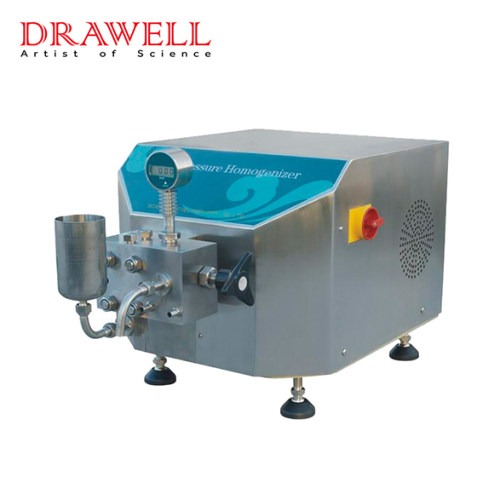
High-pressure homogenizer HPH is an online dispersion machine with excellent efficiency, energy savings, and continuous ultrafine emulsion generation. In contrast to other IKA in-line equipment, the HPH's dispersing action is not based on the rotor/stator principle. Self-decompression of the liquid from up to 2000 bar to ambient pressure improves homogenization in the homogenizer.
Drawell high-pressure homogenizer HPH uses the same amount of energy as standard gear ring dispersers while producing more acceptable emulsions. High-pressure homogenizers are advised for disintegration down to the nanoscale; nevertheless, these homogenizers achieve lower flow rates than traditional dispersions.
How to Use a High Pressure Homogenizer?
1. Installation
Install the high-pressure homogenizer on a flat and sturdy desktop, then one by one install the high-pressure pump, homogenizer valve, pressure gauge, check valve, sample tank, and other components (each component is relatively independent and can be disassembled and installed independently).
Prepare an air compressor or nitrogen tank and circulate cooling water at the same time. The air compressor or nitrogen tank is used to supply the minimum pressure (5-10bar) required by the dynamic homogenization valve, as well as the pressure when the pipeline is flushed and the circulation cooling. When the sample is chilled, water is employed as a cold supply to guarantee that the sample maintains a low temperature during the homogenization process, avoiding sample denaturation and inactivation.
2. Cleaning and Disinfection
Before beginning the machine, inspect the complete sample path to confirm that the tubing is clean. Remove all components from the entire sample channel, then rinse with pure water, then 0.5M NaOH for a short period, and finally warm water.
After cleaning, each component can be sterilized with hot steam, and the pipeline can be sanitized for about 10 minutes after installation using a hot steam cycle.
3. Operation
Before starting the homogenizer, inspect the homogenized liquid to ensure that it is free of contaminants. Impurity particles, particularly metal particles, will harm the pipeline and the homogenizing valve, reducing the homogenizer's service life.
Examine the high-pressure homogenizer's pipeline to confirm that all components are correctly mounted and sealed, and that all bolts are securely fastened. Check the air supply (compressor or nitrogen tank, for example) to ensure that the needed pressure is available; Check the cooling water to ensure that the cooling circulation water was produced ahead of time in accordance with the process requirements, and that the cooling water pipeline was connected.
The small amount of liquid remaining in the pipeline is entirely drained before the HPH of the high-pressure homogenizer begins to work, and the sample is placed into the sample tank and pre-homogenized twice under air pressure.Then, depending on the job needs, increase the homogenization pressure and begin homogenization. Following the completion of the homogenization, the pressure is decreased to zero and the substance liquid is discharged.
4. Maintenance
Immediately after homogenization, rinse with warm water and 0.5M NaOH in a cycle, followed by a rinse with clean water. It can be adequately aerated and pressured during this operation to speed up the cycle and rinse the pipeline more quickly and thoroughly. To finish the cleaning process, rinse 1-2 times with 50% alcohol.
Fill the sample tank and tubing with 70% alcohol solution for the next use after cleaning. If the entire pipeline needs to be sterilized, a hot steam cycle for around 10 minutes is used after the cleaning is finished.
Finally, switch off the power, turn off the air source and cooling water, and so on.
Precautions for Using High Pressure Homogenizer
1. Homogenizing pressure
The homogenization pressure of the high-pressure homogenizer is determined by the material and liquid properties. To minimize unexpected pressure changes, the pressure should be progressively increased during the process of increasing the pressure.
The material homogenization pressure should normally not exceed 2000bar during the homogenization process. To a certain extent, the high-pressure homogenizer allows for overload operation. For a limited period of time, the equipment can operate at 20% overpressure. The control box circuit will then immediately activate the cut-off protection mechanism, which will stop the machine from running. It can be turned back on and work after 30 seconds.
If the pressure cannot rise during the homogenization process, it means that the upper one-way valve is blocked, just use a thin iron wire to pass the ball valve.
2. What Should You Do If the Sample in the High-Pressure Homogenizer Has Air Bubbles?
A high-pressure homogenizer equipped with a dynamic homogenization valve enables the sample to contain air bubbles or to be emptied.
When the sample contains air bubbles or is empty, the homogenizing valve stem and valve seat will clash to some amount during the homogenization process, causing significant wear on the valve stem and valve seat, especially for the manually adjusted homogenizing valve, not only during the homogenization process but also thereafter. It is simple to wear down the homogenizing valve and even directly lead to its fragmentation, rendering it inoperable. Furthermore, it will generate a lot of noise during the homogenization process.
The dynamic homogenizer valve will reduce its damage and noise better, but it is generally recommended to avoid the long-term use of samples containing a large number of air bubbles and the occurrence of empty samples in the pipeline, which can effectively prolong the service life of the homogenizer valve.

3. What Should You Do If Liquid Leaks From the High-Pressure Homogenizer?
There are no o-rings or gaskets in the high-pressure homogenizer's whole sample route, and all face seals are precision-machined metal-to-metal or metal-to-ceramic seals that do not leak liquids.
However, if it is installed incorrectly, if the sample tank and one-way valve are not entirely buckled, or if a component is not properly installed after disassembly, liquid leakage will occur. At this point, all that remains is to inspect the pipeline and install each component appropriately in accordance with the installation manual's specifications.
If the sample is poisonous and harmful, it will endanger and pollute the operating environment and operators. In this case, the above phenomenon can be avoided by simply tightening the sample tank and then flushing the sample passage with air and pressure.