
Density measurement plays a crucial role in laboratory research and industrial applications. Whether analyzing the purity of substances, ensuring quality control in manufacturing, or conducting scientific experiments, accurate density measurements are essential. Laboratories rely on specialized density measurement instruments to achieve precision and repeatability in their results.
The Importance of Density Measurement in Laboratories
Density, defined as mass per unit volume, is a fundamental property of materials. It helps determine composition, purity, and consistency in various substances, from liquids and gases to solids. In laboratory settings, density measurement is widely used in fields such as pharmaceuticals, petrochemicals, food and beverage testing, and material science. The ability to measure density accurately enables researchers and manufacturers to maintain high-quality standards and optimize production processes.
Types of Density Measurement Instruments
Several types of instruments are used in laboratories to measure density, each tailored for specific materials and applications.
1. Digital Density Meters
Digital density meters use oscillating U-tube technology to measure the density of liquids with high precision. These instruments are widely used in pharmaceutical, chemical, and beverage industries due to their accuracy, ease of use, and fast results. Many digital density meters also feature temperature compensation, ensuring reliable measurements under varying conditions.

2. Hydrometers
Hydrometers are traditional instruments used for measuring the density or specific gravity of liquids. They consist of a calibrated glass tube with a weighted bulb that floats at a level corresponding to the liquid's density. Although simple and cost-effective, hydrometers require manual reading and are less precise compared to digital alternatives.
3. Pycnometers
Pycnometers are glass containers used to determine the density of solids and liquids by measuring their mass and volume. These instruments are particularly useful for measuring the density of powders, granular materials, and irregularly shaped solids. Pycnometers provide highly accurate results but require meticulous handling to avoid errors.
4. Gas Pycnometers
Gas pycnometers measure the density of solids using gas displacement techniques. By analyzing the volume of gas displaced by a solid sample, these instruments provide accurate density measurements, even for porous materials. They are commonly used in materials science and pharmaceutical applications.
5. Hydrostatic Balances
Hydrostatic balances determine the density of solids and liquids by comparing their weights in air and in a liquid of known density. This precision analytical balance is useful for measuring the density of irregularly shaped objects and is widely used in quality control laboratories.

Applications of Density Measurement Instruments
Density measurement instruments serve various industries and research fields, including:
Pharmaceutical Industry: Ensuring correct formulation and concentration of drugs.
Petrochemical Industry: Measuring fuel density to assess quality and compliance with standards.
Food and Beverage Industry: Determining the density of beverages, oils, and dairy products for consistency and quality control.
Material Science: Characterizing polymers, ceramics, and metals based on their density properties.
Environmental Studies: Monitoring the density of wastewater and other industrial effluents to assess pollution levels.
Choosing the Right Density Measurement Instrument
Selecting the appropriate density measurement instrument depends on factors such as the type of material being analyzed, required precision, and laboratory workflow. Digital density meters offer high accuracy and automation, while traditional methods like hydrometers and pycnometers are more cost-effective for routine analysis. Gas pycnometers and hydrostatic balances provide specialized solutions for unique applications.

Conclusion
Density measurement instruments play a vital role in laboratory analysis, ensuring accurate material characterization across multiple industries. Advances in digital technology have improved the precision and efficiency of these instruments, making density measurement faster and more reliable than ever before. As laboratories continue to demand high-quality data, investing in the right density measurement instrument remains crucial for achieving consistent and reproducible results.
The dairy industry, a cornerstone of the global food supply, relies heavily on precise control of milk properties throughout processing. Density meters, essential tools for measuring the mass per unit volume of milk, play a pivotal role in ensuring quality, consistency, and efficiency in dairy production.

Understanding Milk Density
Milk density is influenced by several factors, including fat content, non-fat solids, temperature, and the presence of air bubbles. Accurate measurement of milk density is crucial for maintaining consistent product quality and meeting regulatory standards.
The Role of Density Meters in Dairy Processing
Automatic density meters are used throughout the dairy production process, from receiving milk to packaging the final product. Key applications include:
Receiving: Assessing the quality and composition of incoming milk.
Pasteurization: Indirectly monitoring milk components to ensure compliance with regulatory standards.
Homogenization: Verifying the effectiveness of the homogenization process.
Separation: Ensuring proper separation of cream and skim milk.
Standardization: Maintaining desired fat content in milk products.
Packaging: Final quality check before packaging.

Benefits of Density Meter Application
Quality Control: Ensuring consistent product quality and compliance with regulations.
Process Optimization: Improving efficiency and reducing waste.
Cost Reduction: Minimizing product waste and optimizing resource utilization.
Product Development: Creating new products with specific attributes.
Quality Assurance: Real-time monitoring of milk quality.
Compliance with Regulations: Avoiding penalties and legal issues.
Traceability: Tracking and tracing milk batches for quality control purposes.
Conclusion
Density meters are indispensable tools in the dairy industry. By providing accurate measurements of milk density, they contribute significantly to quality control, process efficiency, and product innovation. As technology advances, the integration of advanced density measurement techniques will further enhance the dairy production process, ensuring a reliable and sustainable supply of dairy products to consumers worldwide.
Density, a fundamental physical property, holds significant importance across various industries and scientific domains. Density meters, specialized instruments designed to measure the density of liquids and solids, employ diverse measurement techniques grounded in established scientific principles. This article provides insights into the operational principles of density meters, elucidating how they facilitate precise density measurements.
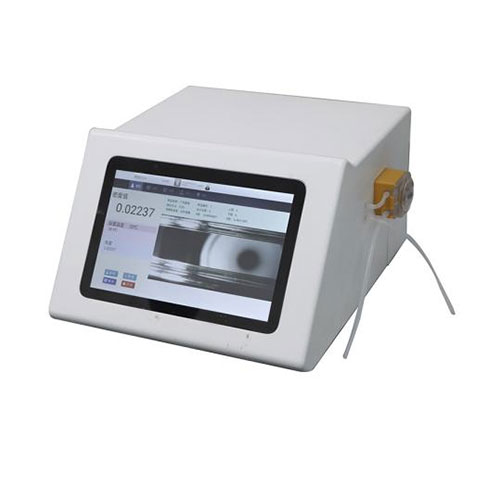
Working Principle of a Density Meter:
The operating principle of a density meter hinges on Archimedes' principle of buoyancy. Here's a stepwise breakdown of how density meters operate:
Buoyancy Measurement:
The sample under examination is placed within a measurement chamber equipped with a transducer or sensor to gauge the buoyant force exerted on the object.
Reference Measurement:
Prior to analyzing the sample, the density meter undergoes calibration using a known density reference material to ensure measurement accuracy.
Sample Introduction:
The sample is introduced into the measurement chamber, which may accommodate either liquid or solid samples, often with provisions for temperature regulation to ensure consistent readings.
Buoyant Force Measurement:
Upon immersion in a fluid, the sample experiences an upward force termed buoyant force, arising from its displacement of the fluid.
Sensor Detection:
The density meter's transducer or sensor detects the buoyant force exerted on the sample, typically converting this measurement into an electrical signal for processing.
Density Calculation:
Leveraging calibration data derived from the reference material, the density meter computes the sample's density based on the measured buoyant force.
Display and Output:
The estimated density value is displayed on the density meter's screen or transmitted to an external device for further analysis. Some density meters offer additional features like temperature compensation or specific gravity calculation.
It's important to note that different types of density meters may employ varying operating principles and measurement procedures. Nonetheless, the underlying principle of measuring buoyant force remains consistent across these instruments.
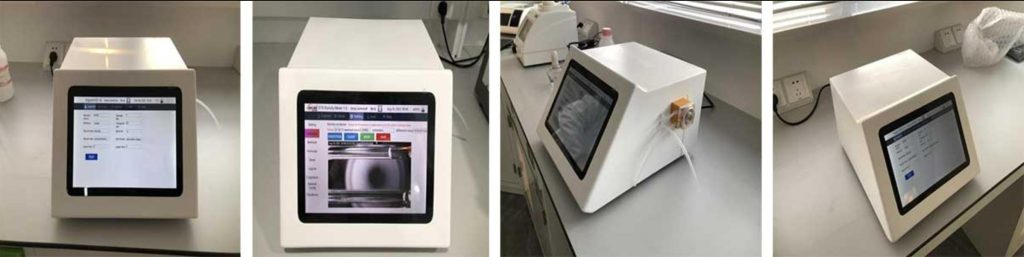
Working Mechanism of Density Meters:
Oscillation-Based Density Meters:
Oscillation-based density meters, including oscillating U-tube and vibrating tube density meters, utilize oscillation frequency to determine density.
Oscillation Initiation: The density meter initiates oscillation or vibration within a chamber or tube, often facilitated by a piezoelectric or vibrating device.
Frequency Measurement: Sensors or transducers in the density meter measure the resonant frequency of the oscillation, which is influenced by the sample's bulk and density.
Comparison with Reference: The measured resonant frequency is compared to a known reference frequency associated with a predetermined density value.
Density Calculation: Based on the frequency difference between the measured and reference frequencies, the density meter calculates the sample's density using calibration data.
Vibrating Element-Based Density Meters:
Vibrating element-based density meters, such as tuning fork density meters, exploit the damping effect on a vibrating element immersed in a fluid to ascertain density.
Vibrating Element: The density meter sets a vibrating element, such as a quartz crystal or tuning fork, into motion at a specific frequency.
Damping Effect: Immersion of the vibrating element in the sample fluid induces a damping effect influenced by the fluid's density.
Frequency Shift Measurement: Sensors or transducers detect the frequency shift in the vibrating element induced by the damping effect.
Calibration and Conversion: The density meter is calibrated using known density reference standards to establish a correlation between frequency shift and density, enabling conversion of the former into a corresponding density value.
Summary:
Density meters serve as invaluable tools for estimating the density of liquids and solids, contributing to quality control, process optimization, and research endeavors. By leveraging established principles like Archimedes' law and innovative measurement techniques, density meters offer accurate and reliable density readings, facilitating breakthroughs across various domains.