
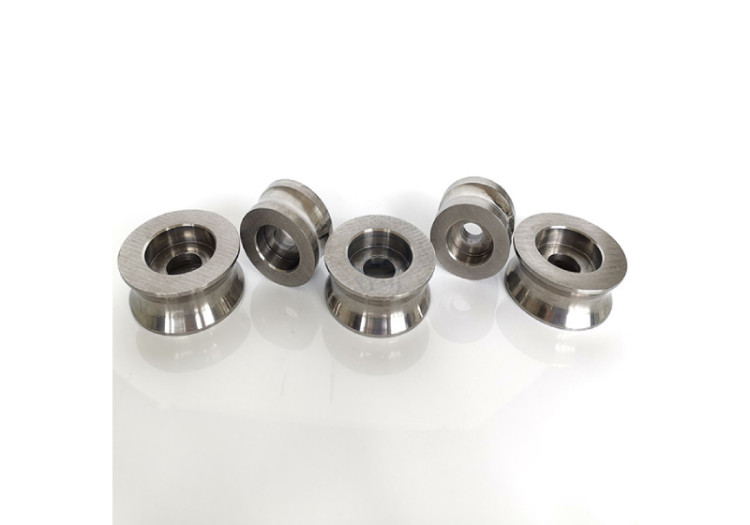
Tungsten carbide products used as wear-resistant parts include nozzle, guide rail, plunger, tire anti-slip nail, shovel snowboard, sweeping shovel, rotary seal ring, grinding mandrel, various pump parts, valve parts, seals, etc.
Carbide wear parts can be widely used as the carbide roller, precision molding & optical molds, stamping molds, drawings, seal ring, piston, bearing journal, and surface hardening welding, spray materials, etc.
How To Improve The Wear Resistance Of Carbide Wear Parts
The wear performance of the tungsten carbide is affected by the use of the environment and alloy performance. The wear resistance is mainly determined by the microstructure and chemical composition. The main structural parameters of the cemented carbide are that grain size and bonding phase content. The wear resistance is also affected by the added elements such as barium.
In industrial production, much important mechanical equipment and their mechanical parts are in harsh conditions, such as high speed, high temperature, high pressure, over-serving, etc., therefore, the damages of mechanical components occur frequently due to wear, corrosion, oxidation, which mostly are caused from the surface. The surface protective measures are used to delay and control the damage, which has become an effective method for solving the wear of mechanical parts. Therefore, various surface abrasion techniques for mechanical parts are adopted, such as plating, thermos, carburizing, nitriding, permeable metals, thermal spraying, surfacing, coating, pasting the hardening layer, high energy beam, etc. The rare earth has been successfully applied in the carbide wear part. When the strength and the impact toughness increase by more than 10%, the wear resistance of the carbide wear parts also has been improved.
Manufacturer Of High Precision Carbide Wear Parts - XYMJ
XYMJ has been committed to providing high-performance carbide products for mechanical industrial production. XYMJ relies on high production technology, professional production equipment, more than 20 years of experience, providing customer high-precision custom carbide wear parts on the basis of the drawings selecting superior materials to maximize the use requirements of customers for carbide wear parts.
XYMJ offers custom parts based on customer’s drawings, producing precision cemented carbide wear parts, using integral carbide materials, half-machined blank, internal threads, direct molding during the blank semi-processing. Surface fine milling can effectively control the dimensional precision machining into finished products.
The high hardness and excellent wear resistance are the basic requirements. According to the special production process of carbide parts, XYMJ adopts the professional vacuum low-pressure sintering process. When the blank is sintered into shape, the internal thread is semi-precision molding, which is convenient for subsequent finishing threaded dimensional accuracy. This is very powerful for tungsten carbide blank sintering and precisely controls the dimensional accuracy of the carbide wear parts.
The requirements for the production and processing of high-precision wear parts are strict and high, which need strong technical support and rich practical experiences with advanced equipment. XYMJ focuses on every detail of production and process, providing customized carbide wear parts, manufacturing according to high-precision applications of customers.
The superior performance of wear-resistant and corrosion make the carbide wear parts are popular in a wide range of industries. XYMJ, specializes in high precision processing and production for carbide wear parts, customized service available.

Wear-resistant components made by tungsten carbide as raw materials can be referred to as carbide wear parts, which have high hardness, strong wear resistance, wide industrial applications. Excellent wear resistance and high hardness make tungsten carbide wear parts suitable for manufacturing mechanical parts and drawing die featuring high-temperature resistance, friction resistance, corrosion-resistant.
What Is The Relationship Between The Hardness And Wear Resistance For Tungsten Carbide
Wear resistance refers to the ability to resist friction, and the tungsten carbide, which is a very widely used material, has high wear resistance. What is the relationship between the hardness and wear resistance for tungsten carbide?
In general, the higher the hardness is, the better the wear resistance. The smaller the particles of the tungsten steel has, the higher the hardness, the better wear resistance. The wear resistance of the cemented carbide is related to the contained proportion of titanium carbide, cobalt carbide. It will be higher hardness and better wear resistance, with more titanium carbide and less cobalt.
The tungsten carbide can reach 86 ~ 93hra at normal temperature, which is equivalent to 69 to 81HRC. High hardness can be maintained at 900 to 1000 ° C with excellent wear resistance. The cemented carbide has been made by a series of refractory metal carbides such as WC, TiC, NBC, and Vc with a powder metallurgical method as a binder. Compared with the superhard material, it has high toughness. Compared to high-speed steel, it has high hardness and wears resistance.
Hardness is an important performance indicator for measuring metal materials, which is the ability of a material to resist elastic deformation, plastic deformation and damage. If other factors have not been considered, the relationship between hardness and wear resistance is that the higher the hardness, the better the wear resistance. Relatively, the same material has different surface treatments, and the hardness is proportional to wear resistance.
However, the material with the best wear resistance doesn’t surely have a high hardness. For example, the hardness of cast iron which is the common wear-resistant material is not high.
Production Process Of Carbide Wear Parts
When the carbide wear parts are made, the particle size of the selected raw material powder is between 1 and 2 microns with high purity. The raw material is an ingredient according to the specified composition, and the alcohol or other medium is added to the wet ball mill for wet grinding, so that they are mixed, pulverized, dried, and sieved to add a type of molding agents such as wax or glue. Then they are dried for the mixture. The mixture granulates, the mold is heated to approaching the bonding metal melting point (1300 to 1500 ° C), and the hardened phase forms a eutectic alloy with the bonded metal.
After cooling, the hardening phase is distributed in the grid composed of bonded metal, close to each other, forming a strong whole. The hardness of the carbide wear parts depends on the content of the hardening phase and the particle size of the grain, that is, the higher the hardening phase content, the finer the grains, the higher the hardness. The toughness of the wear parts is determined by the bond metal, the higher the bond metal content, the greater the bending strength.
Applications Of Carbide Wear Parts
The tungsten carbide wear parts have a series of excellent performance, good wear resistance, high strength and toughness, heat resistance, corrosion resistance, etc., especially their high hardness and excellent wear resistance, providing powerful product support and excellent performance for industrial production, helping improve production efficiency and extend the service life of the equipment.
Applications
1.Suitable for making cast iron rolls and high-nickel-chromium rolls to repair molded knives.
2. Used for making unloading plates, stamping die, convex mold, electronic level molding, and other stamping dies.
3. In the pump, compressor and mixer, the tungsten carbide seal is applied as a mechanical sealing surface.

4. Carbide wear parts can be used on the metal ring in the spinning and weaving industry, which is to prevent rumors and displacement of phenantomers from rotating at high speeds and allows the machine to operate smoothly.
For more useful information, please visit the article page of what is carbide wear parts.

With high hardness, excellent wear resistance & corrosion resistance, tungsten carbide has a high performance in the high-tech manufacturing field which has a strict requirement of quality, stability and reliability.
Characteristics of tungsten carbide
1. High hardness and wear resistance. Generally, between HRA86 ~ 93, decreases with an increase in cobalt.
2. Thermohardening. Under the temperature of 500°C is basically unchanged and there is still a high hardness at 1000°C.
3. High anti-bending strength. The bending strength at normal temperature is between 90 and 150 MPa and the higher the cobalt, the higher the anti-bending strength.
4. More stable chemical properties. Carbide material has acid-resistance, alkali-resistant, and even significantly oxidation even at high temperatures.
5. High thermal conductivity. Cemented carbide has higher thermal conductivity than that of high-speed steel, which increases with the increase of cobalt.
6. The coefficient of thermal expansion is relatively small. It is lower than high-speed steel, carbon steel and copper, and increases with the increase in cobalt.
The manufacturing method of tungsten carbide
The production of the cemented carbide is to mix tungsten carbide and cobalt in a certain proportion, pressurize into various shapes, and then semi-sintered. The sintering temperature is 1300-1500°C.
When manufacturing cemented carbide, the selected raw material powder has a particle size between 1 and 2 microns, and the purity is very high. The raw materials are mixed according to the specified composition ratio, and the medium is added into the wet ball mill to wet-grind them for making them fully mixed and crushed. After drying and sieving, the forming agent is added, and then the mixture is dried and sieved. Then, when the mixture is granulated and pressed, and heated to close to the melting point of the binder metal (1300-1500°C), the hardened phase and the binder metal will form a eutectic alloy. After cooling, a solid whole is formed. The hardness of cemented carbide depends on the hardened phase content and grain size, that is, the higher the hardened phase content and the finer the grains, the greater the hardness. The toughness of cemented carbide is determined by the bond metal. The higher the content of the bond metal, the greater the bending strength.
Hardness test of tungsten carbide
The cemented carbide is a metal, which can reflect the difference in mechanical properties in chemical components, tissue structures, and heat-treatment process. Therefore, the hardness test is widely used in the inspection of carbide properties, which can supervise the correctness of the heat treatment process and the research of new materials. The hardness detection of tungsten carbide mainly uses a Rockwell hardness tester to test HRA hardness values. The test has a strong shape and dimensional adaptability of the test piece with high efficiency.
For more professional information, please visit the introduction page of tungsten carbide knowledge .
Tungsten carbide has high hardness and wear-resistance, The cutting speed of carbide tools is 4 to 7 times higher than that of high-speed steel with 5 to 80 times higher service life. Carbide products can cut hard materials of about 50HRC.
Cemented carbide is mainly micron-sized powders of carbides (WC, TiC) of high-hardness refractory metals. The main components are powder metallurgical products sintered in a vacuum furnace or a hydrogen reduction furnace with cobalt (Co), nickel (Ni), and molybdenum (Mo) as the binder.
The matrix of cemented carbide is composed of two parts: one part is the hardening phase and the other part is the bonding metal.
The hardened phase is the carbide such as tungsten carbide, titanium carbide, and tantalum carbide. Their hardness is very high, and their melting points are above 2000°C, and some even exceed 4000°C. The existence of the hardening phase determines the carbide has extremely high hardness and wear resistance.
Tungsten carbide WC grain size requirements for cemented carbide use different grain size WC according to different applications.
Carbide cutting tools
Carbide cutter is widely used for metal cutting and machining. Fine machining alloys such as foot cutter blades and V-CUT knives use ultra-fine, sub-fine, and fine-grained WC; rough-machining alloys use medium-grain WC; gravity cutting and heavy-duty cutting alloys use medium and coarse Granular WC as raw material.
carbide brazed tips
Carbide mining tools
The rock has high hardness and a large impact load. Coarse WC is adopted, and the rock impact is small with a small load. Medium-sized WC is used as raw material.
carbide mining tips
Carbide wear-resistant parts
When emphasizing its wear resistance, compression resistance and surface finish, adopt ultra-fine, sub-fine, fine, and medium-grain WC as raw material and use medium and coarse-grain WC raw materials as the main material for impact-resistant carbide wear parts.
tungsten carbide parts
The theoretical carbon content of WC is 6.128% (atomic 50%). When the carbon content of WC is greater than the theoretical carbon content, free carbon (WC+C) appears in the WC. The presence of free carbon causes the surrounding WC grains to grow during sintering, resulting in uneven grains of cemented carbide. Tungsten carbide parts generally requires high combined carbon (≥6.07%), free carbon (≤0.05%), and total carbon is determined by the production process and scope of application of cemented carbide.
The bonding metal is generally iron group metals and cobalt and nickel are commonly used.
The tungsten carbide products can be used as cutting tools, mining tools, wear parts, widely applicable for military, aerospace, machining, metallurgy, oil drilling, etc. Wide application and high-quality stability greatly increase the demands for carbide products.
Tungsten carbide rod

Having premium quality carbide rods is the base of furtherly machined high precision finished carbide parts. XYMJ has a professional production line with strict quality for carbide rods, manufactured by high-precision grind machines, skilled workers. XYMJ carbide rods adopt advanced technology and high standard material, mainly used in the manufacture of metal cutting tools, wood, plastics and other industries that require hardness and wear resistance & corrosion resistance. It has stable mechanical properties, easy welding, high wear resistance and high impact resistance.
Process flow
The main process flow includes powder milling formula according to application requirements → wet milling → mixing → crushing → drying → sieving → adding forming agent → re-drying → sieving to obtain a mixture → granulating → pressing → forming → low-pressure Sintering → Forming (blank) → Cylindrical grinding and fine grinding (the carbide blank does not have this process) → Detecting dimensions → packaging → warehousing.
Applications
Cemented carbide rods are mainly used for drill bits, end mills, and reamers. It can also be suitable for cutting, stamping and measuring tools. It is Applicable in paper-making, packaging, printing, and non-ferrous metal processing industries.
Grades YG6, YG8, YG6X are more wear-resistant than MK6. It can be used for hard wood, processing aluminum alloy profiles, brass rods and cast iron, etc. YG10 is resistant to abrasion, knocking, and is used for processing hard wood, soft wood, ferrous metals and non-ferrous metals.
Tungsten carbide rods can be used not only for cutting and drilling tools but also can be applied as input needles, various roll wear parts and structural materials. In addition, it can be widely used in many fields, such as machinery, chemical industry, petroleum, metallurgy, electronics and defense industries.
Tungsten carbide rotary burr

The tungsten carbide rotary burr can be used to process cast iron, cast steel, carbon steel, alloy steel, stainless steel, hardened steel, copper and aluminum. Since the carbide rotary burr is hand-controlled on a high-speed rotation, the pressure and feed speed are determined to the service life and cutting effect of the tool.
Advantages
1. It can process iron, cast steel, carbon steel, alloy steel, stainless steel, copper, aluminum, etc and non-metals such as marble, jade, bone. Processing hardness can reach HRA ≥ 85.
2. Basically, it can replace a small grinding wheel and no dust pollution.
3. High production efficiency. The processing efficiency is more than ten times higher than the handmade file and is nearly ten times that of the small grinding wheel with the handle.
4. Good processing quality and high finish. It can be processed in various high-precision shape mold cavities.
5. Long service life. Durable is ten times higher than that of high-speed steel tools, which is more than 200 times higher than small grinding wheels.
6. Easy to use, safe and reliable.
7. Comprehensive processing costs can be decreased by several times.
Applications
1. Finishing various metal mold cavities such as shoe molds, etc.
2. Various metals and non-metallic process engraving, craft gift engraving.
3.Clean up the feed, burrs, weld of the casting, forging, welding in machine casting factories, shipyards, automotive plants, etc.
4.Chamfered rounds and trench processing, cleanup pipelines, finishing pipelines, and mechanical plants, repair shops, etc.
5.Decoration of the impeller flow path in the automobile engine factory.
Tungsten carbide Dies

The carbide dies have several tens of times longer service life than steel molds. The carbide mold has high hardness, high strength, corrosion resistance, high-temperature resistance and small expansion coefficient, generally composed with tungsten cobalt.
Grades and production technology
The grades mainly include YG3, YG6, YG6X.YG8.YG15, YG20, YG20C, YG25 and HU20, Hu222, HWN1, etc.
Tungsten carbide dies to adopt native carbide material with special low-pressure sintering processes. The toughness will be better than routine production and the service life will increase by 3-5 times.
Classification
The carbide mold can be divided into three categories according to the applications.
1. Tungsten brushed mold, which is the most used carbide mold. The main grades include YG8, YG6, YG3, followed by YG15, YG6X, YG3X, a new grade YL used for high-speed brushes.
2. Cold rolling die & shaped mold, the main grades include YC20C, YG20, YG15, CT35, YJT30 and MO15.
3. Nonmagnetic alloy molds for magnetic materials production, such as YSN series including 20, 25, 30, 35, 40 and steel knot-free magnetic die tags TMF.